Key Takeaways
- Panels win on daily cleaning because there is little or no grout. Tile wins on design, and cement grout is the part that needs sealing; epoxy grout does not.
- "Solid surface" covers several products. Corian-type sheets and reinforced panels such as Swanstone are made differently, and acrylic wall systems are a third category.
- A curbless entry and a tiled bench call for tile. Acrylic conversions pair with a low-curb base.
- Scratches in solid surface can often be sanded out. A cracked panel usually has to be replaced, while one cracked tile can be swapped.
- With Bulldog, an acrylic Tub-to-Shower Conversion costs $10,000 to $13,000. A Signature Tile Shower costs $13,000 to $17,000.
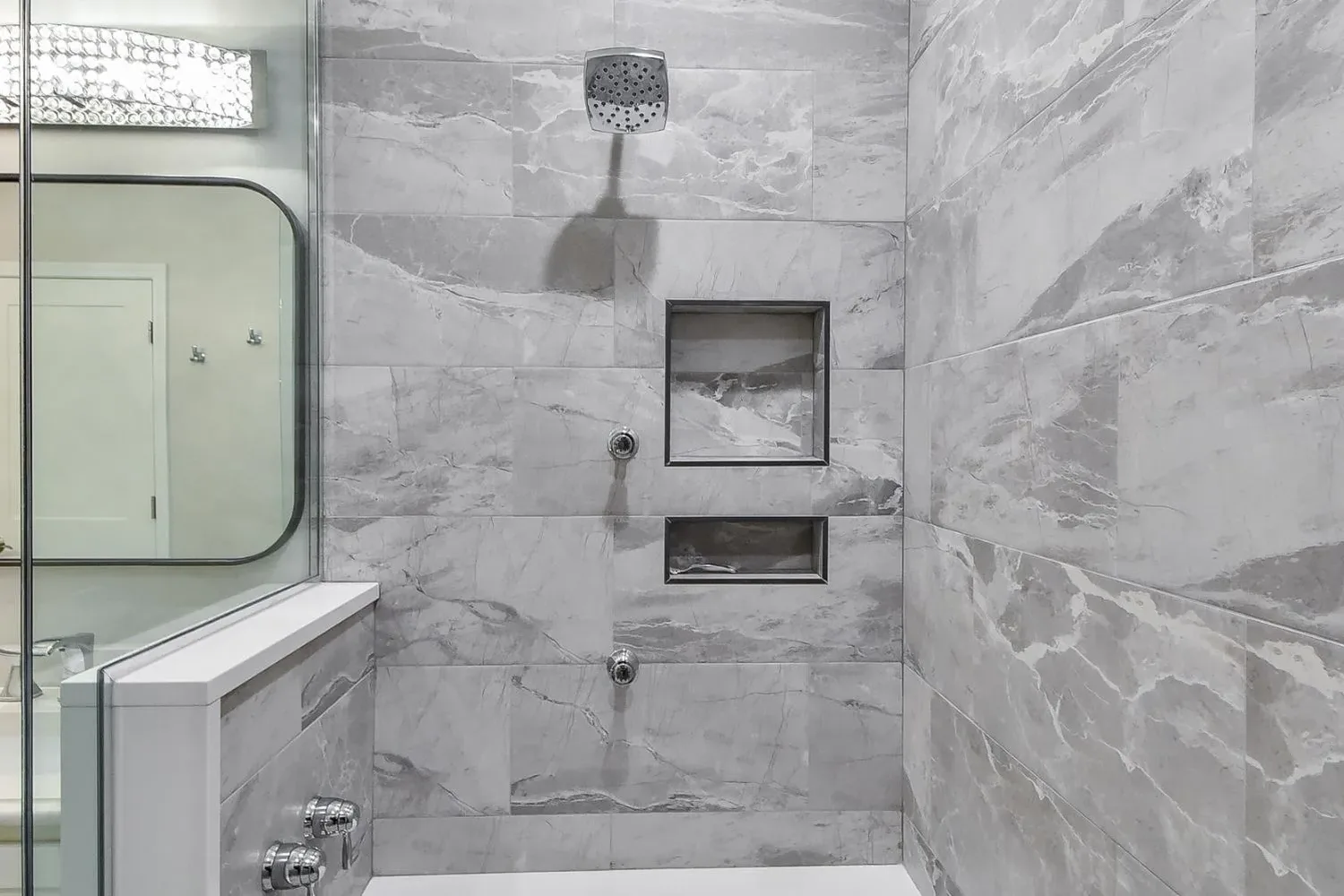
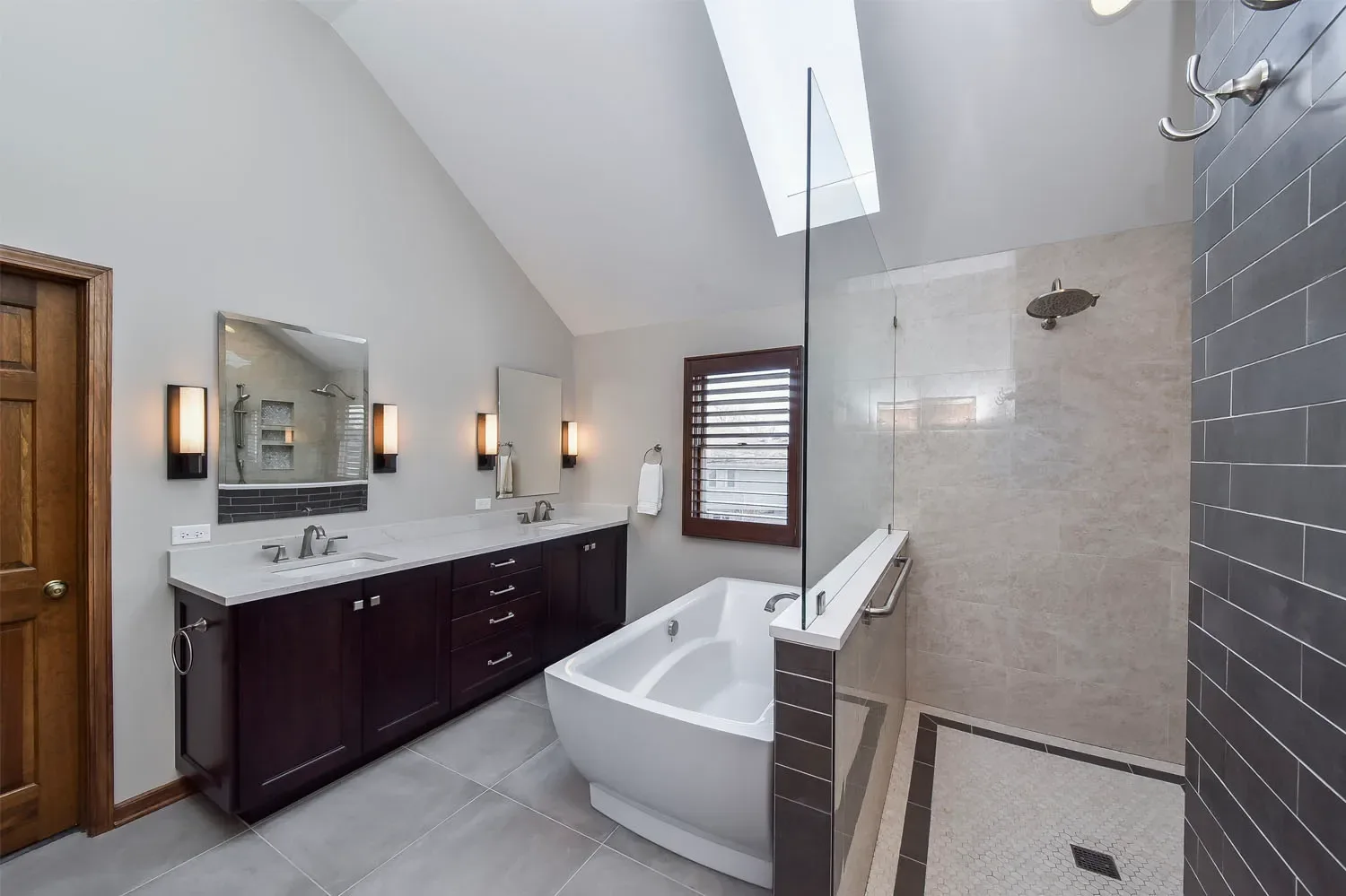
Choose tile if you want design freedom: patterns, built-in niches, a bench, a curbless floor and almost any look you can picture. Choose solid-surface or acrylic panels if you want walls with few or no grout lines that wipe clean and cost less. Both make a durable shower when the backer and waterproofing behind them are right, so the decision comes down to looks, cleaning and budget. The marble-look tile shower at the top, with two niches, is from our Marble and Movement master and powder bath remodel.
What "solid surface" means
Showrooms use the term loosely, and the products under it differ in how they are made, how thick they are and how they repair.
Solid surface, in the Corian sense, is a sheet material generally described as resin blended with mineral filler, the same family as Corian countertops. Corian shows it as a shower wall material and says it is "nonporous, so stains do not penetrate the surface." It adds that "there are no visible joints or cracks to collect dirt and moisture" (Corian).
Reinforced solid surface is a molded panel. Swanstone describes its material as "a compression-molded, thermoset material consisting of a blend of polymer resins, fillers, and reinforcement additives" (Swanstone FAQ). Its standard wall panel measures 36 by 96 inches and 1/4 inch thick, and the maker says the "color and texture run all the way through and cannot wear away" (Swanstone product page).
Acrylic wall systems are acrylic panels sized to the shower or tub alcove. Our walk-in Tub-to-Shower Conversion uses a Triple-Lock Seam acrylic wall surround, and our Acrylic Bath System for tub and shower combos uses a Triple-Lock Seam acrylic wall system.
All three share the main advantage: big sheets with few seams and no grout. When you compare quotes, ask which of the three you are getting, because a price for "solid surface walls" can mean very different materials.
Shower wall panels vs tile, side by side
| Tile | Solid-surface and acrylic panels | |
|---|---|---|
| Cleaning | Grout lines need scrubbing; cement grout needs sealing | Wipe down; few or no grout lines |
| Design freedom | Any size, color, pattern, mosaic or stone | Limited to the maker's colors and textures |
| Niches and benches | Built in and tiled to match | Limited to what the wall system offers, such as a niche and shelving |
| Curbless entry | Yes, with the floor built down to a linear drain | Acrylic conversions pair with a low-curb base |
| Repairs | A cracked tile can be replaced; grout can be redone | Scratches can often be sanded out; a crack usually means a new panel |
| Waterproofing | Membrane behind the tile carries the load | Panel seams, corners and the base joint must stay sealed |
| Price with Bulldog | Signature Tile Shower $13K to $17K | Acrylic Tub-to-Shower Conversion $10K to $13K |
Tile: more choices, more joints
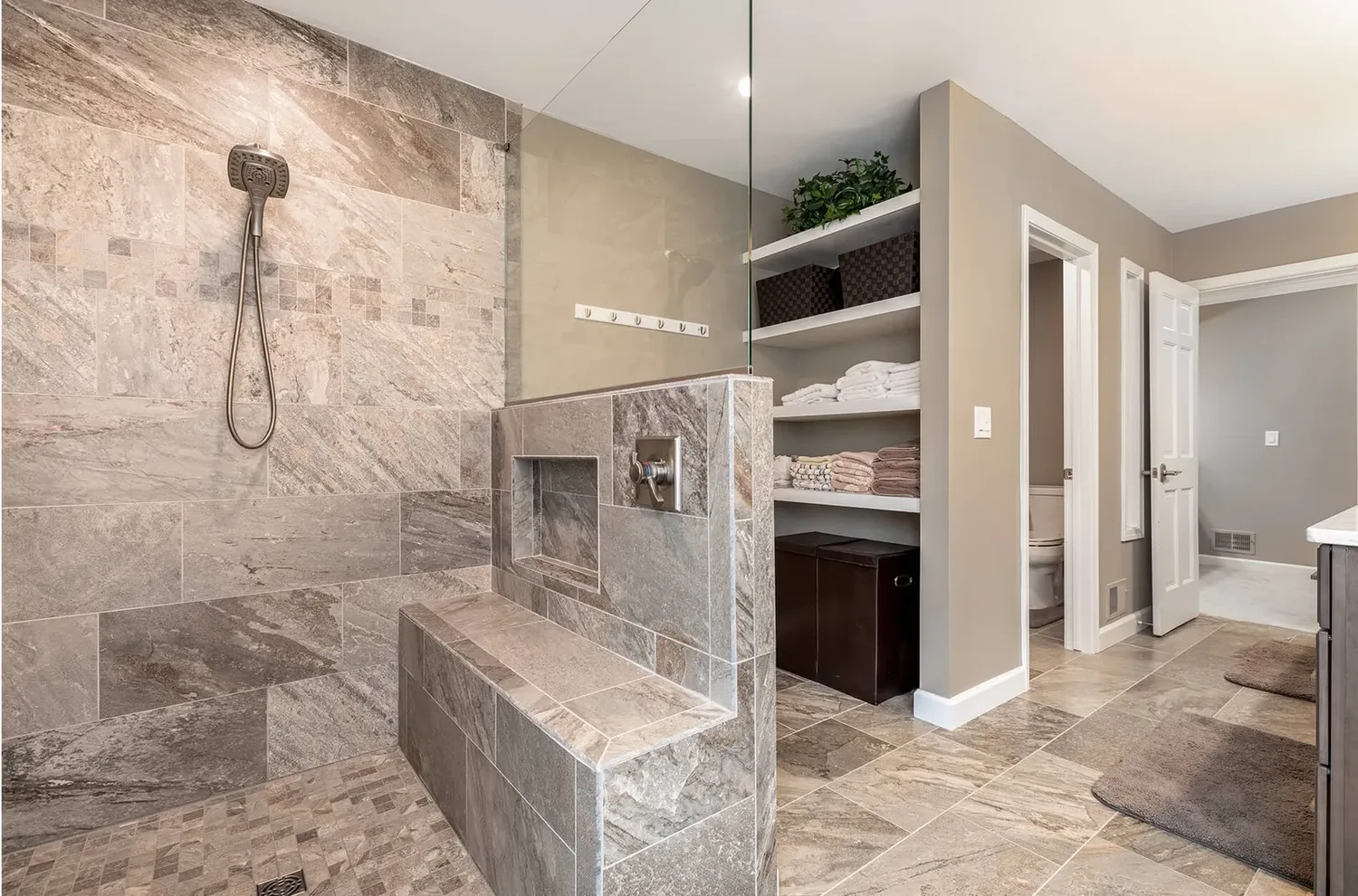
Tile can do things panels cannot. You can run large-format porcelain floor to ceiling, set a mosaic band, frame a niche in a contrasting tile or carry the floor tile into a curbless shower. Our Signature Tile Shower includes porcelain or ceramic tile, a built-in tile niche with an accent strip, a built-in bench seat and a frameless glass enclosure, all over a Schluter KERDI waterproofing system.
The upkeep depends on the grout. Cement grout is the traditional cement-based grout, and Mike Guertin told Fine Homebuilding that "cement-based grouts will absorb water and bathing products." Epoxy and single-component urethane or acrylic-silicone grouts "are easier to keep clean and don't require sealers" (Fine Homebuilding, March 16, 2022).
That changes the usual "tile means sealing" advice. Our own tile guidance is to seal cement grout once it has cured and reseal it as the manufacturer recommends. Epoxy grout costs more up front but resists stains without sealing.
Bigger tiles also cut the grout. Guertin noted that "large-format tile (2 ft. or larger) can cover a shower wall in three to six pieces and minimize grout lines." The trade-off is installation: wall-sized tiles "take special tools and skill to cut and install." Our Signature Tile Shower uses 12 by 24 inch or large-format porcelain or ceramic for the same reason.
Panels: fewer seams, faster cleanup
Panels win on cleaning. With few or no grout lines, a squeegee or a wipe handles most of it, and there is no grout to seal. Swanstone sums up the appeal: "No grout to maintain; will not mold or mildew" (Swanstone product page). That matters to people who do not want to scrub, and to households planning for the years when scrubbing gets harder.
Panels also cost less with us. Our Tub-to-Shower Conversion pairs a Triple-Lock Seam acrylic wall surround with an anti-slip ADA-approved acrylic base, a new shower valve, trim and rainfall head, and a sliding or hinged framed glass door. For tub and shower combos, our custom wall systems come in tile, stone or solid surface.
The limits are design and accessories. You choose from the maker's colors and textures. Built-in storage depends on the system: our Upgraded Combo, for example, includes a custom wall system with niche and shelving, but you will not get the free sizing and placement that tile allows.
Repairs work differently too. Swanstone says "very fine scratches can be buffed out with an abrasive general cleanser," and deeper ones can be worked with "fine grit sandpaper (360 or 400 grit)" (Swanstone FAQ). A crack is another matter. It usually means replacing the whole panel, where a tile wall lets you swap one piece.
What the code asks of any shower wall
Both materials have to meet the same rules. The Residential Code of Ohio says shower walls "shall be finished with a nonabsorbent surface" extending "not less than 6 feet (1829 mm) above the floor" (R307.2, via UpCodes).
A backer is the board behind the finished wall. The code covers backers "for wall tile in tub and shower areas and wall panels in shower areas." They must come from an approved list and be "installed in accordance with the manufacturer's recommendations" (R702.4.2). The list includes glass mat gypsum, fiber-reinforced gypsum, fiber-cement and fiber mat cementitious boards. Plain drywall is not on it.
Greenboard does not solve the problem either. Some panel sellers still describe gluing panels to it, but the code says water-resistant gypsum board "shall not be used where there will be direct exposure to water" (R702.3.7.1). Homes in Northern Kentucky and Southeast Indiana follow their own state codes, so check with your local building department.
The backer and the waterproofing behind it decide how long the shower lasts. A Fine Homebuilding reader described a prefab surround that "pulled away from the wall and buckled, letting water behind it." We cover the layers in what happens behind your shower walls.
Which one fits your household
Tile tends to fit when:
- You want a curbless entry, a bench or niches sized and placed where you want them.
- The shower is the centerpiece of a primary bathroom and you want a specific look.
- You are fine with grout care, or willing to pay more for epoxy grout.
Panels tend to fit when:
- Easy cleaning is the top priority.
- You are converting a tub in a hall or guest bath and want to stay near $10,000 to $13,000.
- A low-curb base suits the people using the shower.
If you are leaning toward curbless, read curbless showers in older homes first. A curbless, zero-entry shower needs the floor built down to a linear drain, so the floor work drives that decision more than the walls. The glass comes next; see frameless or semi-frameless shower glass.
Cost and timing with Bulldog
Bath services start at $10,000. Our walk-in showers come in three tiers. The acrylic Tub-to-Shower Conversion runs $10,000 to $13,000, and the Signature Tile Shower runs $13,000 to $17,000. The Luxury Spa Shower, in natural stone or designer porcelain, runs $17,000 to $20,000+ (walk-in shower cost page).
Tub and shower combos follow the same pattern. The Acrylic Bath System costs $10,000 to $12,000, and the Upgraded Combo costs $12,000 to $15,000. A Tiled Tub & Shower, with a tile surround over a fully waterproofed wall, costs $15,000 to $20,000+ (tub/shower combos).
Each shower or combo is designed and built around your household and your space. Either way the work takes around 4 days, and you get your dates in writing before we start. For the rest of the room, see our bathroom remodel guide.
Frequently asked questions
Do acrylic or solid-surface walls look cheap?
Some people think so. One Fine Homebuilding reader wrote that "solid-surface enclosures look cheap, and add less value than a tile or stone application." Others choose panels for what the same article calls "the seamless look you get with glass, solid surface, stone, and quartz panels." Today's panels come in stone and tile looks, and clean trim at the edges makes a big difference.
Can panels go over my old tile?
Some can. Swanstone says its panels "glue up over existing surface." The risk is that you are trusting whatever sits behind the old tile. In our walk-in conversions, the walls are waterproofed from the floor up rather than just above the old tub rim.
Which is easier to keep clean?
Panels. With few or no grout lines, a wipe-down handles most cleaning. Tile with epoxy grout narrows the gap, since it does not need sealing.
Which lasts longer?
Both can last for decades when the backer and waterproofing are right. Tile lets you replace one piece at a time; panels have fewer joints for water to find.
Get a fixed price for your shower
Book an in-home consultation and we will measure your shower, go over tile and panel walls for your space, and give you an itemized, fixed price in writing. You can also browse our walk-in showers or call us at (513) 657-3750.
Sources
- Ohio Board of Building Standards, 2019 Residential Code of Ohio, via UpCodes: Section R307.2 and Sections R702.3.7.1 and R702.4.2.
- Scott Gibson. Tub and Shower Surrounds Without the Tile. Fine Homebuilding, March 16, 2022.
- Corian Design. Corian for Bathroom Surfaces.
- Swanstone. Frequently Asked Questions.
- Swanstone. SS-3696-1 36" x 96" Bathtub and Shower Wall Panel.