
Key Takeaways
- Sound, well-set 1950s tile can stay. Hollow-sounding tile, a soft floor or stains on the ceiling below mean the room needs to be opened up.
- The color is the easy part. Failed shower waterproofing, old supply lines and a missing exhaust fan are what usually need replacing.
- Homes built before 1978 fall under the EPA's lead-safe renovation rule, and old vinyl floor tile and adhesives may contain asbestos. Test before demolition.
- A full bathroom remodel with Bulldog runs $15,000 to $55,000+ and takes 4 to 8 weeks from the first design meeting to the final walkthrough.
Knowing how to remodel a 1950s bathroom starts with one decision: keep the pink, mint or yellow tile and update around it, keep part of it, or take the room to the studs. Keep the tile if it is tight, the shower is dry and you like the color. Open the room up if the tile is loose or cracked, the floor gives underfoot, or water has been getting behind the walls. New grout and paint can't fix any of those.
Why so many Cincinnati homes have pink bathrooms
Pastel tile was the standard bathroom finish in postwar houses, and Greater Cincinnati and Northern Kentucky built plenty of them. Pam Kueber of Retro Renovation estimates that "some 5 million pink bathrooms went into the 20 million+ homes built in the United States from 1946-1966" (Retro Renovation). The National Park Service credits Mamie Eisenhower directly: "Her love of the color pink helped make it one of the most popular colors of the 1950s" (National Park Service). Yellow, blue, green and gray rooms went in during the same era.
Many of those rooms are still intact. Whether yours should stay depends on what is behind the tile.
Pink tile bathroom remodel: keep, mix or replace
Check the condition first, then decide how you feel about the color. A tile job that is sound and dry can last for decades more. One that is loose or wet won't be saved by new grout.
| Option | When it fits | What changes |
|---|---|---|
| Keep the tile | Tile is tight, the shower is dry, you like the color | Vanity, lighting, mirror, paint, fan, accessories |
| Keep part of it | Wall tile is sound but the floor or shower has failed | Shower or floor rebuilt, wall tile stays and sets the palette |
| Replace everything | Loose or cracked tile, soft floor, leaks, mold | Full remodel to the studs |
Three quick checks tell you which row you are in. Tap the wall tile with a knuckle or a screwdriver handle; a hollow sound over a wide area means the tile has let go of the wall. Press on the floor next to the tub and in front of the toilet, where any give points to a damaged subfloor. Then check the ceiling of the room below for water stains. Any one of those signs points to opening the room up.
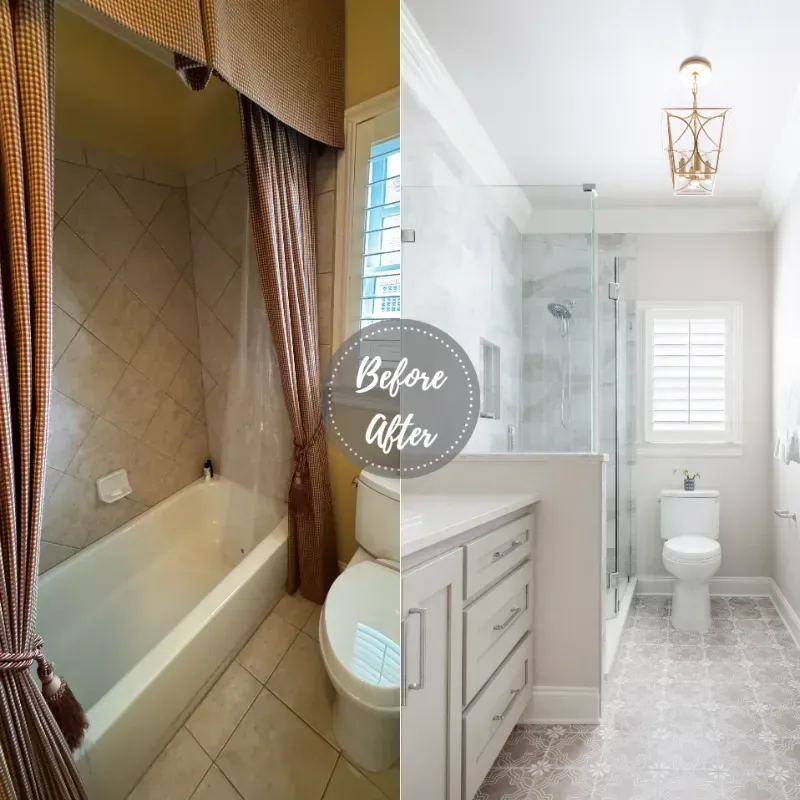
Keeping part of a vintage room takes planning. Old tile is hard to match, and salvage tile is sometimes available, but colors and sizes rarely line up exactly. A partial job usually looks best when the new work is a clear contrast, such as a neutral floor under original wall tile.
If the walls are sound and only the tub has to go, a walk-in shower is the middle path. Bulldog designs and builds each one around the household, and a conversion runs $10,000 to $20,000+. The work takes around 4 days, and you get the schedule in writing. As our cost page puts it, that route "makes sense when the rest of the room is in good shape."
If you keep the tile
Work with the color instead of against it. Pink and mint look dated next to beige paint and a 1990s oak vanity, and they look deliberate next to white, black, chrome or brass.
- Regrout and recaulk where the grout is cracked or the caulk has failed at the tub.
- Replace the vanity and lighting. A furniture-style vanity and good light at the mirror change the room more than anything else you can do without touching tile.
- Add an exhaust fan if the room only has a window. Ohio's code calls for a window with at least 3 square feet of glass, half of it openable, or artificial light and an exhaust fan that sends air "directly to the outdoors" (Residential Code of Ohio, R303.3, via UpCodes). Our article on bathroom fans, moisture and mold covers sizing.
- Consider a new shower valve if yours is the original two-handle type. Ohio's plumbing code says shower and tub-shower valves "shall be balanced-pressure, thermostatic or combination balanced-pressure/thermostatic valves." They also "shall be equipped with a means to limit the maximum setting of the valve to 120°F (49°C)" (Ohio Plumbing Code, 412.3, via UpCodes). Northern Kentucky homes follow Kentucky's own plumbing code.
A pressure-balance valve is a shower valve that holds the mix of hot and cold steady when pressure changes elsewhere in the house, such as when someone flushes a toilet.
Keeping an old cast-iron tub is often possible too. If the enamel is sound, it can be refinished in place and new walls built around it. If it is chipped through or the drain needs work, replacing it is usually the better long-term value.
What is usually behind 1950s tile
The color is the visible problem. The ones that matter are hidden.
- The tile setting bed. Mud-set tile is tile set into a thick bed of mortar, and many tile walls of that era were built this way. That makes demolition heavier and slower than pulling tile off drywall.
- Old shower waterproofing. Grout lets water through over time, and once the layer behind it fails, water reaches the framing and subfloor. Our article on hidden water damage in an old shower shows what that looks like when the wall comes down.
- Old supply lines and drains. The EPA notes that lead pipes "are more likely to be found in older cities and homes built before 1986." It adds that the most common problem is "brass or chrome-plated brass faucets and plumbing with lead solder" (EPA). We put new supply lines, drains and P-traps into every full bathroom remodel.
- A soft subfloor. Years of small leaks around the toilet and tub rot the wood. We replace damaged subfloor before any new floor goes down, because tile only lasts when what's under it does.
- No ventilation. If the room never had a fan, peeling paint and ceiling stains usually show it.
Older Cincinnati houses turn up these problems often enough that Bulldog builds them into the price. Subfloor repair, mold treatment and new plumbing parts are quoted at the start of a full remodel, so they don't show up later as change orders.
Lead and asbestos: test before demolition
A 1950s bathroom predates the federal ban on lead-based house paint, and some flooring from that era contains asbestos. Both become a hazard when demolition breaks them up. Testing is your call as the homeowner, and it should happen before anyone swings a hammer.
The RRP rule is the EPA's Renovation, Repair and Painting rule. It applies to work that disturbs lead-based paint "in homes, child care facilities, and kindergartens built before 1978," and firms doing that work "must be EPA- or state-certified" (EPA). If you hire anyone to disturb painted surfaces in a 1950s house, ask whether their firm holds that certification.
For asbestos, the EPA lists planning a remodel as a reason to have a "trained and accredited asbestos professional" inspect your home. It also warns, "Don't sand or try to level asbestos flooring or its backing" (EPA). The EPA lists vinyl floor tile, sheet-vinyl backing and adhesives among materials that may contain asbestos (EPA, Learn About Asbestos). Only a test tells you for sure. If you plan to keep the floor, the EPA's advice for asbestos flooring that needs replacing is to "install new floor covering over it, if possible" (EPA).
How to remodel a 1950s bathroom, step by step
A full update takes the room to the studs and rebuilds it. With Bulldog the process runs 4 to 8 weeks from the first design meeting to the final walkthrough. Most of that time goes to design, selections and material lead times, not work in your house. The order of work:
- Design and selections. Layout, vanity, tile, fixtures, lighting and paint colors are all chosen before construction starts.
- Demolition and haul-away. The old tile, the tub and the wall material behind them come out. Finish any lead or asbestos testing before this step.
- Repairs. Mold treatment, subfloor replacement and framing repairs happen next, before anything is closed up.
- Rough-in. New supply lines, drains, the shower valve, the fan duct and electrical go in.
- Waterproofing and tile. We use the Schluter KERDI waterproofing system to form one continuous membrane on the shower walls and under the base. It slopes to the drain and gets water-tested before any tile goes on.
- Finish and walkthrough. The vanity, toilet, glass, lights and paint go in, followed by a final walkthrough with you.
Our article on how long a bathroom remodel takes breaks down the schedule. The Cincinnati bathroom remodel guide walks through layout, materials and budget decisions in more depth.
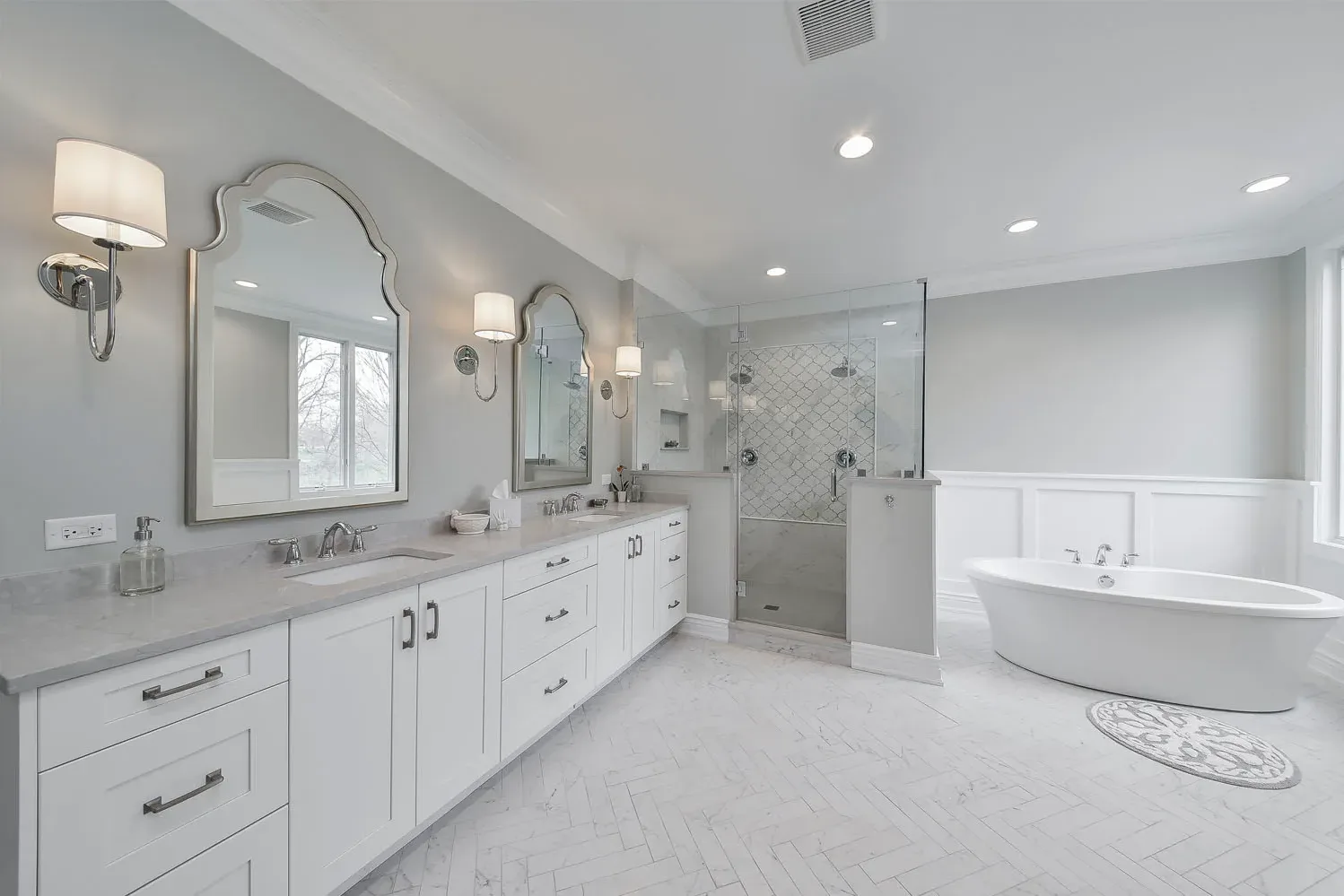
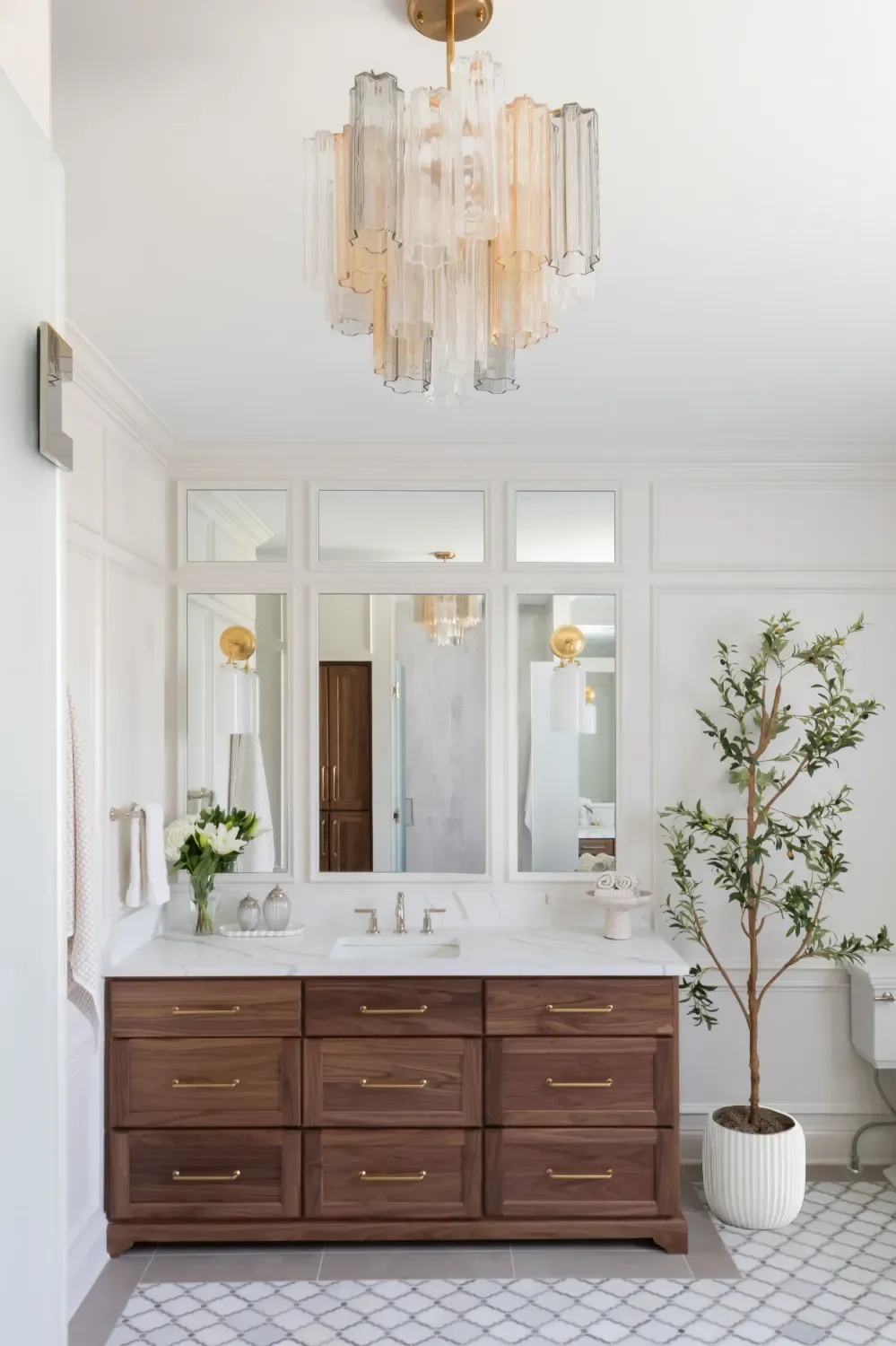
A nod to the era. Many homeowners who replace vintage tile still want the room to suit the house. Patterned floor tile, white wall tile, a pedestal or furniture-style vanity and period lighting fit a mid-century house without copying the pink.
Frequently asked questions
Can I paint over pink tile?
Tile paint exists, but it holds up worst in wet areas, so ask the maker about shower use before you buy. It does nothing for loose tile or water damage behind it.
Can I replace just the pink tub, sink and toilet?
Yes, if the tile around them is sound. A tub set into a tile wall usually can't come out without removing the tile around it, so plan for that. If the tub is cast iron with sound enamel, refinishing it in place is another option.
How much does a full 1950s bathroom update cost?
With Bulldog, a full bathroom remodel runs $15,000 to $55,000+, and every bath service starts at $10,000. A 1950s hall bath kept in the same footprint, fully gutted and rebuilt with modern finishes, usually fits our $15,000 to $25,000 Essential Bath. Our bathroom remodel cost guide shows what moves the number.
Plan your bathroom update
Book an in-home consultation, and we will look at the tile, the floor and the plumbing and walk you through what to keep and what to replace. See our full bathroom remodels, or call us at (513) 657-3750.
Sources
- Pam Kueber, Retro Renovation. 9 facts about vintage pink bathrooms. Updated November 15, 2023; archived site.
- National Park Service, Eisenhower National Historic Site. Virtual Tour.
- Ohio Board of Building Standards, 2019 Residential Code of Ohio, Section R303.3, via UpCodes.
- Ohio Board of Building Standards, 2024 Ohio Plumbing Code (effective March 1, 2024), Section 412.3, via UpCodes.
- U.S. Environmental Protection Agency. Lead Renovation, Repair and Painting Program Rules.
- U.S. Environmental Protection Agency. Basic Information about Lead in Drinking Water.
- U.S. Environmental Protection Agency. Protect Your Family from Exposures to Asbestos.
- U.S. Environmental Protection Agency. Learn About Asbestos.