Key Takeaways
- For a bathroom floor, look for a wet DCOF of 0.42 or higher on the tile's spec sheet. Crossville rates that as Interior Wet, for indoor floors that get wet now and then. Shower floors fall in a separate class, Interior Wet Plus.
- Real porcelain absorbs 0.5% water or less under the ASTM C373 test. A PTCA certification mark confirms it.
- "Waterproof" luxury vinyl means the planks resist water. Water can still reach the subfloor at the edges, so Daltile calls for 100% silicone caulk around wet areas and the toilet flange.
- Electric floor heat needs GFCI protection, a clear zone under vanities and the toilet, and a cure period before it is switched on.
- With Bulldog, installed prices run $4 to $10 per square foot for luxury vinyl, $12 to $25 for porcelain or ceramic tile and $20 to $35 for heated tile.
For most bathrooms, porcelain tile is the best bathroom flooring: it absorbs almost no water, lasts the longest and passes heat from a heated floor as well as stone and better than vinyl, laminate or wood. Luxury vinyl plank fits when you want a softer, warmer floor at a lower price, as long as its edges are sealed around the toilet and tub. A heated bathroom floor works under either one, but tile lets far more of the heat through.
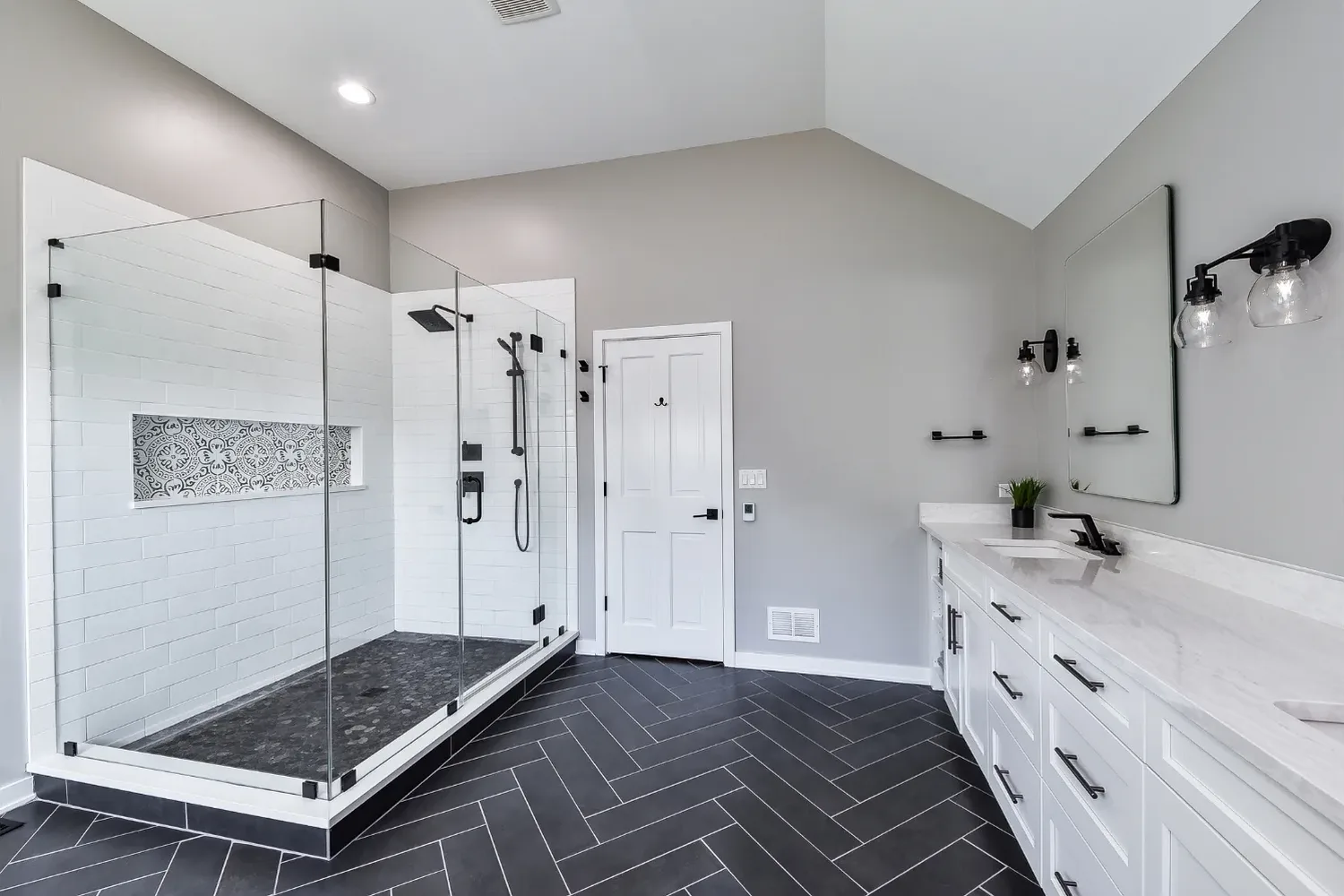
This post goes past the basics on our bathroom flooring page into the numbers on the spec sheet and the details of the install. The photo at the top is the charcoal herringbone floor in our Dreamy Details master bath, with a pebble mosaic on the shower floor. For the full sequence of a bath project, start with our bathroom remodel guide.
Porcelain, luxury vinyl and heated tile side by side
| Feature | Porcelain tile | Luxury vinyl plank | Heated porcelain tile |
|---|---|---|---|
| Water | Absorbs 0.5% or less; cement grout needs sealing | Waterproof planks; edges and seams need care | Same as porcelain |
| Slip resistance | Check the wet DCOF on the spec sheet | Varies by product texture | Same as porcelain |
| Feel underfoot | Hard and cool | Softer and warmer | Hard and warm |
| Subfloor demands | Stiff, flat floor and a backer or uncoupling membrane | Flat, solid floor with no deflection | Same as porcelain, plus the heating system |
| Works with heat | Best, because tile passes heat well | Possible, with a lower temperature cap | Built in |
| Bulldog installed price | $12 to $25 per sq ft | $4 to $10 per sq ft | $20 to $35 per sq ft |
Most bathrooms run 40 to 100 square feet. At the top of the heated tile range, 100 square feet at $35 comes to $3,500.
Porcelain tile: read the spec sheet
Porcelain tile is an impervious tile with a water absorption of 0.5% or less, measured by the ASTM C373 test method. The Tile Council of North America (TCNA) warns that some sellers market tile that fails this standard as porcelain. Its Porcelain Tile Certification Agency (PTCA), launched with the Ceramic Tile Distributors Association, certifies tile that passes and licenses a mark for the box (TCNA, porcelain tile certification).
Slip resistance is the next number to find. DCOF, or dynamic coefficient of friction, measures how much grip a tile surface gives a moving foot. ANSI A326.3 is the test for it, released in 2017 and now part of the ANSI A137.1 tile specification (TCNA, DCOF).
Crossville, a U.S. porcelain maker, sorts tile into use classes by that number:
- Interior Wet (IW) requires a wet DCOF of 0.42 or greater. It covers areas "intended to be kept dry, but may intermittently be exposed to water," with home kitchens and baths among the examples.
- Interior Wet Plus (IW+) "may be suitable for interior areas that are frequently subjected to standing water," and Crossville lists shower floors as an example.
So the main bathroom floor needs an IW rating, and the shower floor needs a tile rated IW+. Ask for the spec sheet before you fall for a polished finish.
An uncoupling membrane is a thin layer set between the wood subfloor and the tile, so small movements in the wood do not crack the tile above. Bulldog's tile floors go over cement board or an uncoupling membrane.
Cement grout needs sealing, and epoxy grout trades a higher price for stain resistance. Our bathroom flooring page, linked above, covers the sealing schedule.
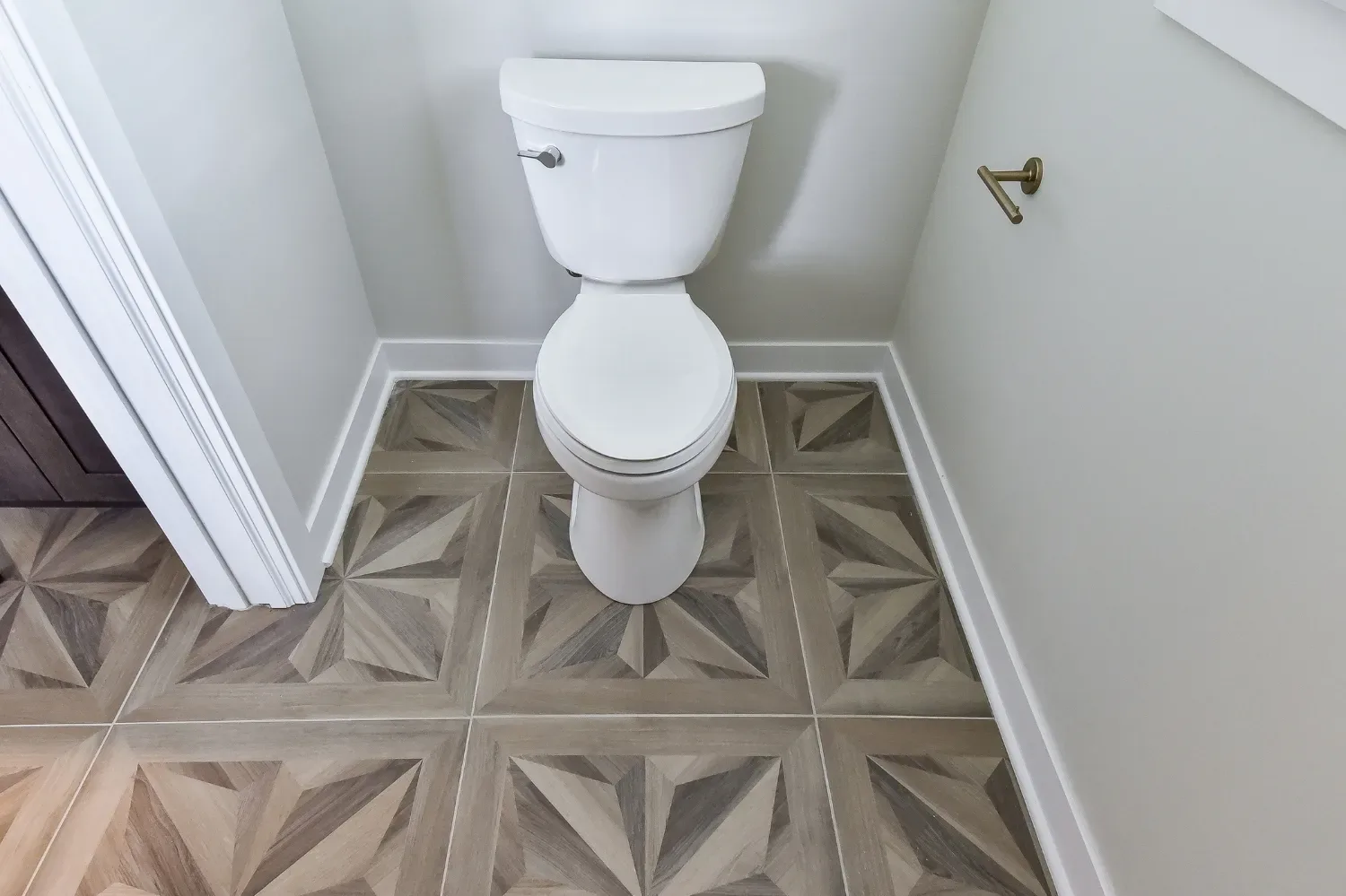
Luxury vinyl plank: where water still gets through
Rigid core luxury vinyl plank is a click-together vinyl floor with a stiff core, installed as a floating floor that is not glued or nailed down. The planks themselves are waterproof, but a floating floor still has seams and a gap at every edge. One maker's guide spells out the limits. Daltile's installation guide for its rigid-core click vinyl says the product "is a waterproof floating floor, but it should not be used to seal an existing floor from moisture." It also "does not inhibit the growth of mold" or prevent damage from flooding (Daltile ProSeries LVF installation guide).
The same guide sets the bathroom details:
- Seal the wet edges. Fill "expansion spaces around potential wet areas only with premium waterproof 100% silicone caulk," including the space left around the toilet flange.
- Do not pin the floor. The planks must not be "glued, nailed, or fastened to the subfloor in any way." The toilet is not anchored through the vinyl, and a fixed vanity goes in first with the floor cut around it.
- Start flat. The subfloor must be "structurally sound without deflection." It can vary no more than 1/4 inch in a 10-foot radius and 1/16 inch under a 3-foot straightedge.
- Mop up standing water. Daltile says to "always remove standing water and other liquids promptly."
Daltile also says not to install the product in rooms "prone to flooding." Our read of the guide: vinyl suits hall baths and kids' baths where a softer floor matters and the shower is a tub or a curbed pan. A curbless shower sends water across the floor, which points to tile. Our post on curbless showers in older homes covers that build.
Heated floors: how they work and where they go
An electric floor heating system is a thin heating cable or mat set in the floor, wired to a thermostat with a sensor in the floor. It warms the floor surface for the hours you set, then switches off. Bulldog's heated tile package uses an electric radiant heating mat with a programmable thermostat, on a dedicated circuit run by our electrician.
Schluter's DITRA-HEAT installation handbook (April 2023), for one cable-in-membrane system, shows what the design involves:
- Power. At its standard cable spacing, the cable puts out about 12.7 watts per square foot. By our estimate, 40 square feet would draw about 510 watts while the heat runs. Real cables come in set sizes, so the actual draw varies.
- Safety. Schluter states that "a Class A (5 mA) ground fault circuit interrupter (GFCI) is required for each circuit." Its own thermostats include one.
- Where the cable cannot go. "NEVER install the heating cable under vanities with no air space beneath," bathtub platforms or freestanding tubs with no air space beneath. The cable also stays at least 7 inches from the centerline of the toilet drain.
- Testing. The installer tests the cable on the spool and again at two later steps, so a damaged cable is found before the floor covers it.
- Cure time. Schluter calls for the assembly to cure "a minimum of 7 days after grouting before putting the floor warming into service."
(Schluter Systems DITRA-HEAT Installation Handbook, PDF hosted by Lowe's)
Bulldog's "around 4 days" for a bathroom floor is the install. Expect the heat to go on after the cure period your system's maker sets, not on day 4.
Plan the heated area around where you stand: in front of the vanity, between the tub and the toilet, and outside the shower door. The cable stays out from under any vanity with no air space beneath and at least 7 inches from the toilet drain.
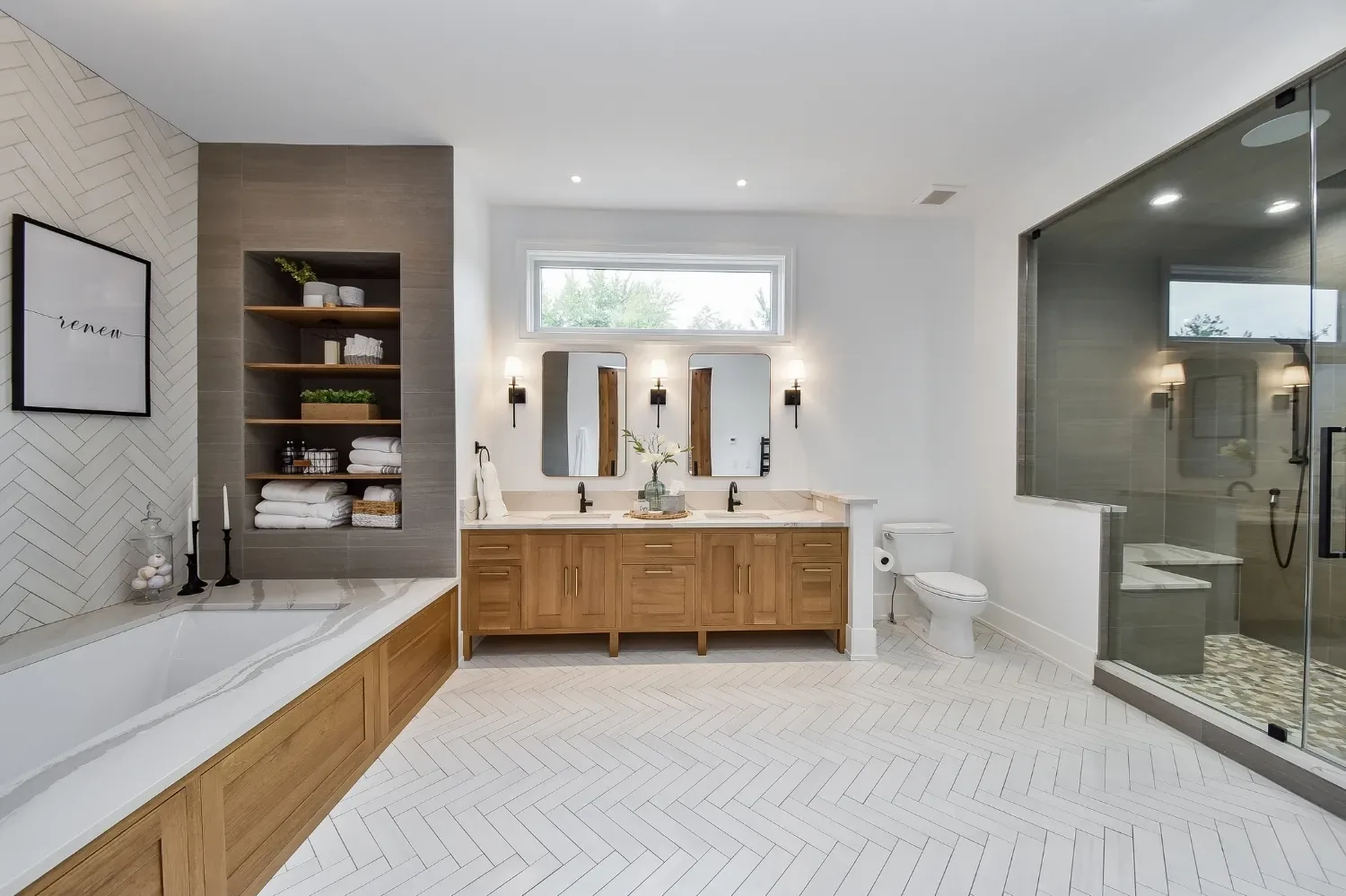
Heated tile vs. heated vinyl
The finished floor over a heating system must not exceed an insulating value of R-1, according to the Schluter handbook. A quarter-inch porcelain tile rates about R-0.024, and quarter-inch vinyl rates about R-0.4. Both qualify. Schluter adds that alternative floor coverings conduct heat "on average 10 times lower" than ceramic, porcelain and stone.
The handbook's lab table shows the difference at the surface. With the thermostat at 82°F in a 72°F room, ceramic, porcelain and stone tile reach 82°F while vinyl floors land a few degrees lower.

Vinyl over Schluter's system also comes with tighter rules. The thermostat "must be set at 82°F (28°C) or lower at all times," the covering must withstand 85°F, and a self-leveling underlayment at least 1/4 inch thick goes over the membrane first. Schluter also says "solid hardwood is not recommended in floor warming applications."
The subfloor decides more than the finish
Any of these floors fails early on a soft or springy subfloor. The 2018 IRC, as adopted in Ohio, limits floor deflection to L/360 (Residential Code of Ohio, Table R301.7, via UpCodes). For tile over its heating membrane, Schluter specifies at least a 19/32-inch (5/8-inch nominal) subfloor on joists 16 inches on center.
Natural stone, which Bulldog also installs, asks more of the floor. The same handbook says natural stone over the heating membrane "requires double layer wood floor regardless of joist spacing." Stone handles heat as well as porcelain: it reaches 82°F in Schluter's lab table, and the handbook's example R-value for 1-inch stone sits well under the R-1 limit.
Many Cincinnati homes are decades old, and rotted subfloor around a toilet or tub is common once the room is opened (Bulldog bathroom remodel costs). With Bulldog, the old floor almost always comes up, the toilet is pulled and reset, and any subfloor repair is quoted after we lift the old floor.
A bathroom floor with Bulldog takes around 4 days, including subfloor prep and, for tile, curing time, and your schedule is fixed in writing before we start. As part of a full remodel, the floor fits into the 4 to 8 weeks from design to finish.
Planning a bathroom from scratch? Read adding a second bathroom for basement and slab floors, and our bathroom lighting guide for the other choice that shapes how the room feels at 6 a.m.
Frequently asked questions
Is luxury vinyl plank OK in a full bathroom with a shower?
Yes, with a tub or a curbed shower, when the edges around the tub, toilet and any wet area are sealed with 100% silicone as Daltile's guide directs. Daltile says not to install its vinyl in rooms prone to flooding, so a curbless shower that drains across the floor generally calls for tile.
Can a heated floor go under luxury vinyl?
Some systems allow it. Schluter lists luxury vinyl among the coverings DITRA-HEAT can go under, with an 82°F thermostat cap, a self-leveling underlayment and tighter cable spacing. Tile still delivers more of the heat to the surface.
Is porcelain tile slippery when wet?
It depends on the finish. A tile with a wet DCOF of 0.42 or higher meets Crossville's Interior Wet class for floors that get wet now and then. Shower floors call for a tile rated Interior Wet Plus, so check the spec sheet.
Can the heat run under the vanity?
Not under a vanity that sits on the floor with no air space beneath, according to Schluter's handbook. Plan the heat for the open floor where you stand.
Talk through your bathroom floor with us
Book an in-home consultation. We come to you, measure carefully and walk through every option in your space, and every quote is locked with our Price Guarantee. See our bathroom remodels or call us at (513) 657-3750.
Sources
- Crossville. Porcelain Tile DCOF Ratings and Applications. Undated.
- Tile Council of North America. Dynamic Coefficient of Friction. August 1, 2025.
- Tile Council of North America. Porcelain Tile Certification. September 9, 2025.
- Daltile. ProSeries Luxury Vinyl Flooring Installation and Care Guide, Rigid Core Click. September 2023.
- Schluter Systems. DITRA-HEAT Installation Handbook (PDF hosted by Lowe's). April 2023.
- Ohio Board of Building Standards, 2019 Residential Code of Ohio (2018 IRC), Table R301.7, via UpCodes.