Key Takeaways
- A walk-in tub has a watertight door, a low step-in and a built-in seat, so you sit to bathe instead of lowering yourself to the tub floor.
- You sit inside while it fills and while it drains, so the supply line, the drain and the water heater matter more than any spa feature.
- In Ohio, the Ohio Plumbing Code caps hot water to tubs at 120°F and requires a pump access opening on whirlpool tubs. Northern Kentucky homes follow the Kentucky State Plumbing Code instead.
- Original Medicare generally does not pay for one, and the VA's home-modification grant excludes Jacuzzi-type tubs.
- With Bulldog, walk-in tubs run $10K to $12K for a soaker up to $18K to $25K+ for a premium spa tub.
A walk-in tub is worth it for someone who still wants to bathe but can no longer lower themselves safely into a standard tub or climb back out. It is the wrong choice for someone who mainly showers, uses a walker, or would struggle to sit in the tub while it fills and drains. A level-entry shower with a bench serves that person better. With Bulldog Remodel Group, an installed walk-in tub costs $10,000 to $25,000+, and the work takes around 4 days with your dates in writing.
What is a walk-in tub?
A walk-in tub is a deep tub with a watertight door in the side wall and a molded seat inside. You open the door, step over a low threshold, sit down, close the door and fill the tub around you.
A typical spec sheet shows how different that is from a standard tub. One manufacturer's 26 by 53 inch model lists a 7-inch step-in height, a 17-inch seat height and a 30-inch soaking depth. It estimates an average fill of 60 to 70 gallons with someone inside (Meditub 2653 specification sheet). Under standards, the same sheet lists ASME A112.19.15.
Other models differ, so the exact tub matters. At Bulldog, the Liquid Accent tub we fit is custom-fabricated to your specs. We design the door side, seat height, grab bars and controls around the person who will use it. Our walk-in tubs page shows the options.
Who a walk-in tub helps
A walk-in tub helps someone for whom bathing matters and the tub wall is the barrier. Typical cases:
- Someone who soaks for joint or muscle pain and does not want to give up baths.
- Someone who can stand and step but cannot get down to the tub floor, or cannot get back up from it.
- A household with a caregiver. A hand shower on a slide bar, controls the helper can reach from outside the tub, and grab bars placed for both people make assisted bathing safer for everyone.
Hydrotherapy options (whirlpool jets, an air spa or both) add warmth and massage. An in-line heater is a heater built into the tub's jet system that, in the Meditub sheet's words, "is designed to maintain water temperature during operation." It does not replace the water heater: the same sheet says it "will not heat cold water to desired bathing temperature."
Who should skip one
Skip a walk-in tub if the person mainly showers. The high walls make it poor for showering standing up, and in a bathroom several people share, that matters every day.
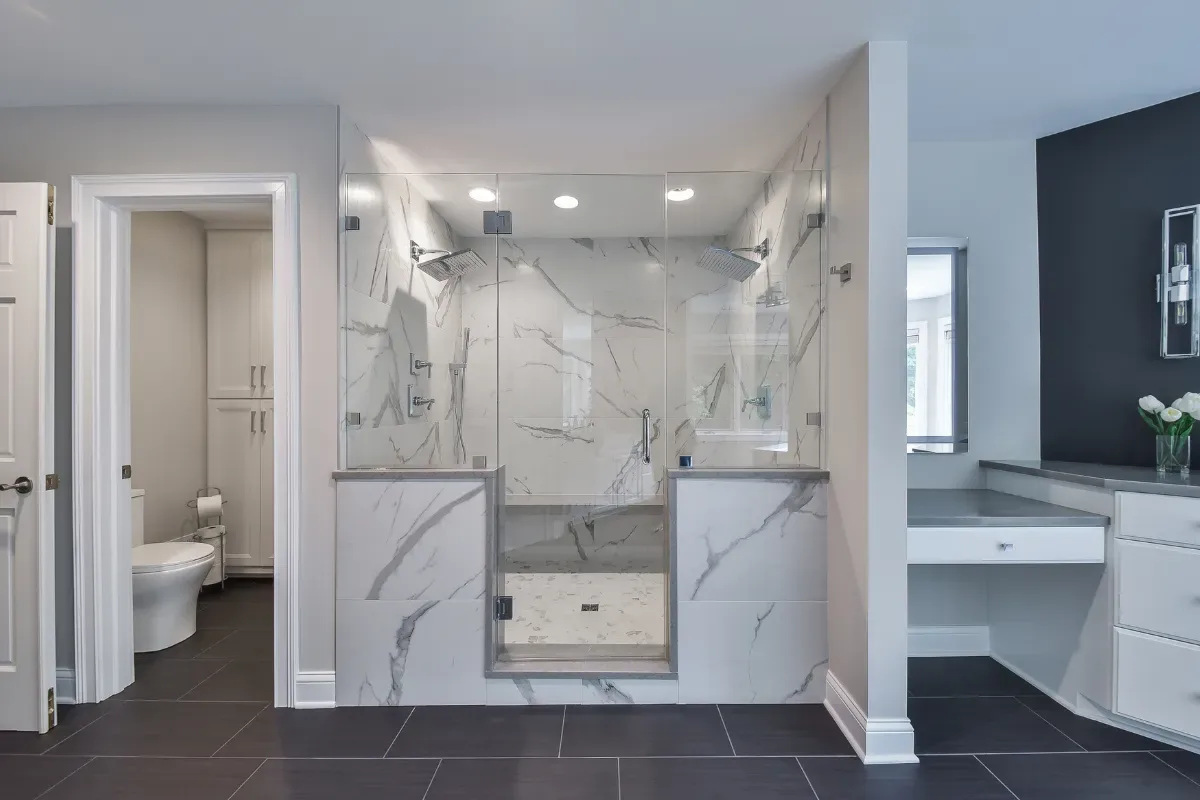
Skip one, too, if the person uses a walker or finds sitting and rising difficult. A level-entry shower is a shower with no curb or step at the entrance, so a person can walk straight in. With a bench and grab bars, it is often the quicker and better fit, and we will tell you that even when the tub is the larger contract. MedlinePlus advises people to "sit on a bath chair or bench when taking a shower" (MedlinePlus, Bathroom safety, adults). Our comparison of a bathtub and a walk-in shower covers that choice in more detail.
Walk-in tub pros and cons
| Pros | Cons |
|---|---|
| Low step-in and a built-in seat | You sit inside while it fills and drains |
| Deep seated soak (the Meditub 2653 lists a 30-inch soaking depth and a 17-inch seat) | Holds far more water than a standard tub |
| Hydrotherapy jets, air spa and heater options | Awkward for standing showers |
| Can be planned for a caregiver | Jetted and heated models typically need their own GFCI-protected circuit |
| Custom-fabricated to the room and the person | Often made to order, so the lead time can run weeks |
What the bathroom injury data shows
Bathroom injuries are common, and the rate climbs steeply with age. In a CDC study of 2008 emergency department data, an estimated 234,094 nonfatal bathroom injuries were treated among people aged 15 and older. Falls caused 81.1% of them, and 68.3% happened in or around the tub or shower. Getting out of the tub or shower accounted for 9.8% (CDC MMWR, June 10, 2011).
The injury rate was 112.1 per 100,000 people aged 65 to 74, 241.0 for ages 75 to 84 and 515.3 for those 85 and older.

The CDC authors wrote that "adding grab bars both inside and outside the tub or shower might help prevent bathroom injuries to all household residents."
Our read of the report: the figures are from 2008, and the study did not look at walk-in tubs. It supports grab bars and an easier way in and out of whatever you bathe in. It does not show that a walk-in tub prevents more falls than a level-entry shower with a bench.
The wait to fill and drain
This is the drawback people underestimate. Because the door has to be closed before the tub fills and cannot open until it drains, you sit in an empty tub while it fills and in a wet one while it drains.
How long that takes depends on the faucet, the supply line and the drain. A fast-fill faucet and a quick-drain valve shorten both waits. In older homes, galvanized pipe that has corroded inside slows the fill, and replacing the run that serves the bathroom while the wall is open fixes it. We measure the fill and drain rates your house can deliver before recommending a model, because a slow fill is the difference between a tub someone uses and one they avoid.
What your house needs to handle
A walk-in tub asks more of the house than a standard tub. We check four things before we specify a model:
- The water heater. We total the tub's volume against the heater's capacity. If the heater falls short, the fix is a smaller-volume model or a heater upgrade, and we price both.
- The floor. A full walk-in tub with a person in it is heavy, so we look at the joists under the bathroom before specifying a model.
- The electrical panel. Whirlpool, air and heater systems typically need their own GFCI-protected circuit, so we check the panel for room on the first visit. The Meditub sheet calls for a 20-amp GFCI circuit for a whirlpool with an in-line heater and a 15-amp GFCI circuit for an air or whirlpool system alone.
- The route in. We measure the whole route from the street to the bathroom at survey, because a walk-in will not angle through a doorway or stair turn the way a standard tub does.
Code points in Ohio, Kentucky and Indiana
In Ohio, two sections of the 2024 Ohio Plumbing Code (effective March 1, 2024) apply, because the Residential Code of Ohio sends home plumbing to that code (RCO 2501.1). Section 412.5 says bathtub and whirlpool bathtub valves "shall have or be supplied by a water-temperature-limiting device that conforms to ASSE 1070/ASME A112.1070/CSA B125.70 or by a water heater complying with ASSE 1082 or ASSE 1084." That device must limit its maximum setting to 120°F (49°C) and, where adjustable, be field adjusted "to provide hot water at a temperature not to exceed 120°F (49°C)" (Ohio Plumbing Code, via UpCodes). MedlinePlus gives the same number for the whole house: set the water heater "to no more than 120°F (49°C) to prevent burns."
Section 426.5 covers whirlpool pumps. The access opening must be at least 12 by 12 inches unless the manufacturer specifies otherwise. Where the pump sits more than 2 feet from the opening, the opening must be at least 18 by 18 inches. In either case it must be unobstructed and big enough to remove and replace the circulation pump. We design that access panel into the surround, because without one, a service call starts by breaking finished tile.
Northern Kentucky homes fall under the Kentucky State Plumbing Code, 815 KAR Chapter 20, instead. We did not find a Kentucky equivalent of these two Ohio sections in 815 KAR 20:070, so the state plumbing inspector confirms the details at inspection. In Kentucky the plumbing permit comes from the state Division of Plumbing, and a state inspector checks the work.
In Southeast Indiana, confirm the requirements with your local building department before you choose a model.
How we build a walk-in tub
Our own team handles the plumbing, electrical and finish work. Behind the surround, our walk-in tubs go in over Triple-Lock Seam backerboard with spray foam insulation, and we replace the subfloor where it needs it.
What a walk-in tub costs with Bulldog
Our installed walk-in tubs fall into three tiers. Each range includes the tub, removal of the old tub, plumbing, electrical for heated models, installation and our lifetime warranty.
- Soaker Walk-In Tub, $10K to $12K: low step-in, sealed door, built-in seat and grab bar, fast-fill faucet and handheld shower.
- Hydrotherapy Tub, $12K to $18K: adds whirlpool jets or an air spa, an in-line heater, a dedicated electrical circuit and a waterproof wall surround.
- Premium Spa Tub, $18K to $25K+: adds combination whirlpool and air massage, aromatherapy and a custom wall system.
Most homeowners choose the $12,000 to $18,000 hydrotherapy tier. Every quote is locked with our Price Guarantee. Many tubs are made to order, so the lead time is weeks rather than days, and then the work in your home takes around 4 days, with the exact dates in writing before we start.
If the tub is part of a full bathroom remodel, that project usually takes 4 to 8 weeks, design to finish. Our bathroom remodel guide covers the whole room.
Does insurance or Medicare pay for one?
Usually not. Original Medicare generally does not pay for a walk-in tub. CMS's durable medical equipment list denies bathtub seats as a "comfort or convenience item," bathtub lifts as a "convenience item" and grab bars as a "self-help device." It covers standard whirlpool bath equipment only for a homebound patient who meets medical criteria (CMS, NCD 280.1).
AARP puts it plainly: Original Medicare "doesn't pay for equipment that it considers to be for comfort or convenience." AARP adds that some Medicare Advantage plans "may include an allowance of up to $500 a year to spend on assistive and safety devices" (AARP, April 10, 2023).
Veterans should know one limit. The VA's Home Improvements and Structural Alterations (HISA) grant excludes the "purchase or installation of spa/ hot tubs/ Jacuzzi type tubs," while it lists "roll in showers" as eligible (VA HISA, last updated February 12, 2025). Grants run up to $6,800 for service-connected cases and $2,000 for others. A jetted walk-in tub is unlikely to qualify, so ask the VA before counting on a grant.
Taxes are a partial help at best. The medical expense deduction is the IRS rule that lets you deduct "only the part of your medical and dental expenses that is more than 7.5% of your adjusted gross income." For home changes made for medical care, "the cost of the improvement is reduced by the increase in the value of your property." IRS examples include "installing railings, support bars, or other modifications to bathrooms" (IRS Publication 502, for 2025 returns). Walk-in tubs are not named, so ask a tax adviser whether yours qualifies. Medicaid and local aging programs set their own rules; ask them directly before you set a budget.
If you are planning a wider set of changes, our aging-in-place bathroom checklist lists what to build in while the walls are open.
Frequently asked questions
Which way should the door swing?
An inward door seals tighter as the tub fills, but it narrows the opening. An outward door gives a wider entry and is easier for someone who transfers from a wheelchair or walker, but it needs clear floor in front. We plan the door around how the person gets in.
Will a walk-in tub fit my existing tub alcove?
Often. Walk-in tubs come in shorter footprints than people expect. We measure the room and the door swing together, not only the alcove.
Can a walk-in tub hurt resale?
In our view, it can, if it is the only tub in the house. Some buyers will see it as a strong feature and others as something to remove. Keeping a conventional tub in another bathroom answers that question.
How long does a walk-in tub last?
No single number applies; it depends on the model and how it is used. Ask the maker about its warranty and about door-seal parts. The seal and latch keep water in while someone sits in a tub they cannot leave until it drains, so they are the components we will not economize on.
See if a walk-in tub fits your bathroom
Book an in-home consultation and we will check your floor, water heater, panel and the route to the bathroom, then give you a locked price in writing. If a shower fits better, you can also browse our walk-in showers or call us at (513) 657-3750.
Sources
- Meditub. 2653 Walk-In Bathtub, 26 x 53, Specification. Sheet v5, 2019.
- Ohio Board of Building Standards, 2024 Ohio Plumbing Code (effective March 1, 2024), Sections 412.5 and 426.5, via UpCodes.
- Ohio Board of Building Standards, Residential Code of Ohio, Section 2501.1 (OAC 4101:8-25-01), via Cornell Legal Information Institute.
- Kentucky State Plumbing Code. 815 KAR 20:070, Plumbing fixtures, via Cornell Legal Information Institute.
- Centers for Disease Control and Prevention. Nonfatal Bathroom Injuries Among Persons Aged 15 Years or Older, United States, 2008. MMWR, June 10, 2011.
- MedlinePlus. Bathroom safety, adults. Reviewed April 9, 2026.
- Centers for Medicare and Medicaid Services. National Coverage Determination 280.1, Durable Medical Equipment Reference List.
- AARP. Does Medicare Cover Home Safety Equipment? April 10, 2023.
- U.S. Department of Veterans Affairs. Home Improvements and Structural Alterations (HISA). Last updated February 12, 2025.
- Internal Revenue Service. Publication 502, Medical and Dental Expenses (2025).