Key Takeaways
- HVI recommends 100 CFM per linear foot of cooking surface for a wall hood and 150 CFM per foot over an island. Its minimums are 40 and 50 CFM per foot. For professional-style cooktops, HVI defers to the cooktop manufacturer.
- Where a hood is installed, Ohio and Kentucky code require its duct to run outdoors, never into an attic or crawl space. Listed ductless hoods are a code exception, but HVI says recirculating hoods "provide no actual ventilation."
- Kentucky requires makeup air for any hood able to exhaust more than 400 CFM (KRC M1503.4). Ohio applies that line only when a fuel-burning appliance inside the air barrier is neither direct-vent nor mechanical-draft vented (RCO M1503.6).
- Fan size is only half the job. Lawrence Berkeley National Laboratory tests found hoods captured more at the back burners, and open hoods captured more than hoods with covered bottoms.
- In our older-home kitchens, a recirculating hood gives way to one vented outside.
A range hood should vent outdoors through a smooth metal duct, and for a 30 to 36 inch range against a wall, the Home Ventilating Institute (HVI) recommends 250 to 300 CFM. The range hood makeup air requirement starts above 400 CFM. In Kentucky, any hood able to exhaust more than 400 CFM needs makeup air. In Ohio, the same line applies only when the house has a fuel-burning appliance that is neither direct-vent nor mechanical-draft vented. Plan the hood, the duct route and any makeup air together with the range.
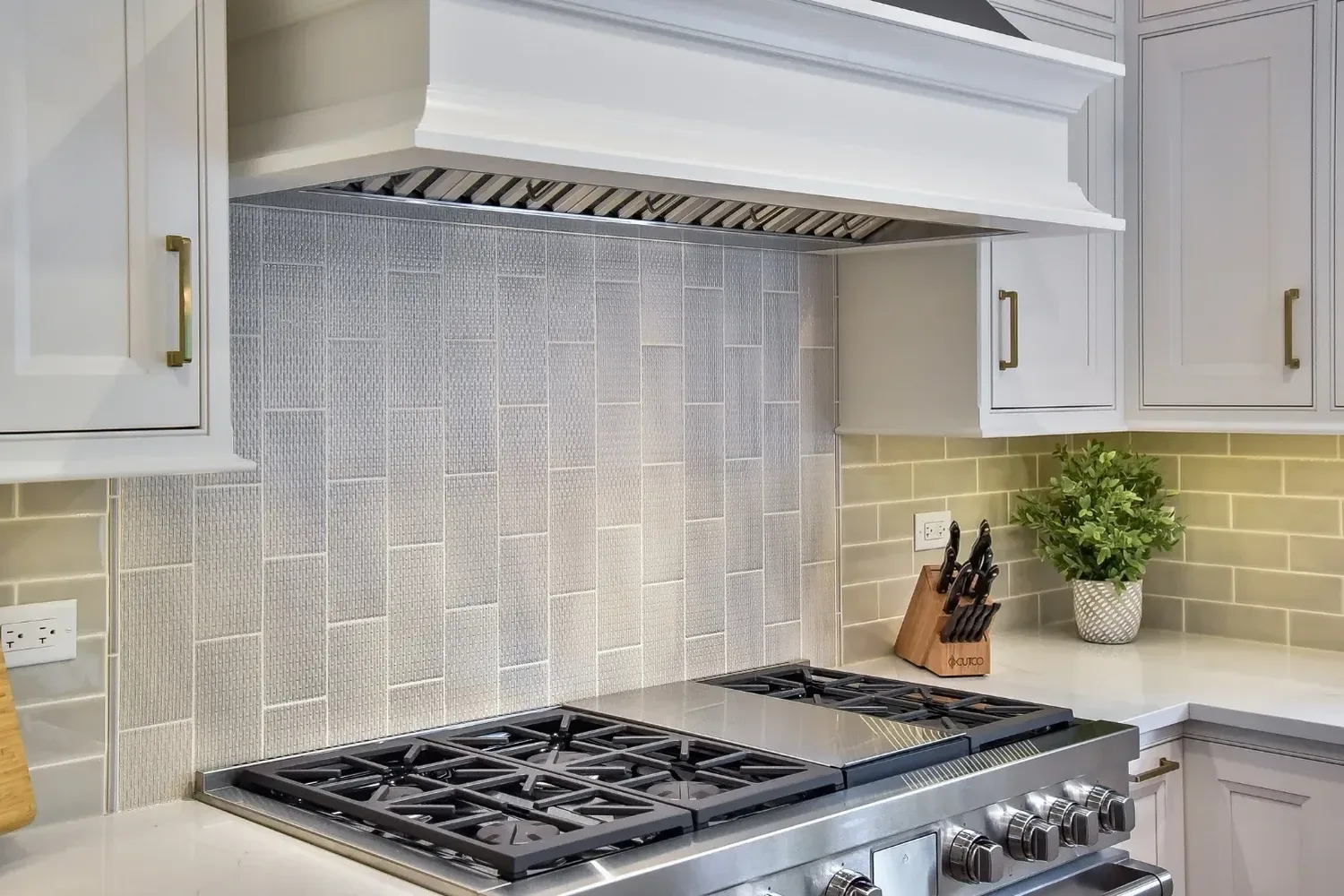
The photo at the top is the range wall in our Traditional Radiance kitchen: a white paneled hood with a stainless liner over a stainless range with burner grates and a griddle.
Step 1: Size range hood CFM to the cooking surface
Start with the width of the range or cooktop, then multiply. HVI recommends 100 CFM per linear foot for a range against a wall and 150 CFM per linear foot for a hood over an island. Its minimums are 40 CFM per linear foot for a wall range and 50 CFM per linear foot for an island (HVI, How Much Ventilation Do I Need?).
| Cooking surface | Wall hood, recommended | Wall hood, minimum | Island hood, recommended | Island hood, minimum |
|---|---|---|---|---|
| 30 inches | 250 CFM | 100 CFM | 375 CFM | 125 CFM |
| 36 inches | 300 CFM | 120 CFM | 450 CFM | 150 CFM |
| 48 inches | 400 CFM | 160 CFM | 600 CFM | 200 CFM |
HVI publishes the wall figures. The island figures are HVI's per-foot island rates multiplied by the width.

Our read of the HVI numbers: a 36-inch island hood sized at HVI's rate (450 CFM) already crosses the 400 CFM makeup air line, and a 48-inch wall hood (400 CFM) sits right on it. Island cooktops and wide ranges are the setups most likely to run into the makeup air rules in Step 3.
Which CFM rating counts
For professional-style cooktops, HVI says to follow "the cooktop manufacturer's advice." HVI also warns that "inflated performance ratings are common for range hoods that are not HVI-Certified." Broan-NuTone, a hood manufacturer, says "the code language is not clear on which rating should be used." In the manufacturer's view, use the HVI-certified rating measured at the standard 0.1 inch of static pressure (Broan-NuTone).
The duct affects real airflow too. Writing for Green Building Advisor, Fernando Pages Ruiz warns that "a narrower duct will choke off the hood, reducing its aspiration capacity," and that "the duct should follow a direct path to the exterior" (GBA, 2022).
Capture matters as much as CFM
Capture efficiency is the share of the pollutants from a burner that the hood actually pulls in and exhausts. In lab tests of seven hoods, Lawrence Berkeley National Laboratory (LBNL) researchers measured capture efficiency from under 15% to over 98%. They found it "was higher for back burners relative to front burners," and that "open hoods had higher CE than those with grease screen and metal-covered bottoms." The best device topped 80% at the oven and front burners, and it had a large, open hood covering most of the front burners. Hoods that met ENERGY STAR's sound and fan-efficacy criteria captured under 30% at the front and oven burners (Delp and Singer, LBNL, 2012). The tests measured burner emissions, not cooking food.
Our read of the LBNL results: choose a hood deep and wide enough to cover the front burners, and cook on the back burners when you can. A strong fan alone does not guarantee the hood catches the plume.
The code floor sits far below HVI's numbers. Where a kitchen exhaust is installed, Ohio's code lists "100 cfm intermittent or 25 cfm continuous" (Table M1505.4.4), and Kentucky's Table M1507.4 sets the same values. Treat that as the inspection minimum for a hood you install, and size the hood for how you cook.
Step 2: Ducted vs ductless range hood (vent it outside)
Ohio's hood rules apply "where domestic cooking exhaust equipment is provided" (M1503.2). Once a hood goes in, the 2019 Residential Code of Ohio says it "shall discharge to the outdoors through a duct" (M1503.3). The duct needs a smooth interior, an airtight build and a backdraft damper, and it can never end in an attic, crawl space or other interior area. Ohio also requires galvanized steel, stainless steel or copper duct (M1503.4) (Residential Code of Ohio, Chapter 15, via UpCodes).
The 2018 Kentucky Residential Code says "range hoods shall discharge to the outdoors through a duct," with the same smooth, airtight, damper and termination rules (M1503.1). Its duct section lists galvanized steel, stainless steel and copper (M1503.2) (Kentucky Residential Code, Chapter 15, via UpCodes).
About ductless hoods. A ductless hood filters cooking air and blows it back into the kitchen. Both codes allow a listed and labeled ductless hood, installed to the manufacturer's instructions, where the kitchen has other ventilation. HVI is blunt about them: "nonducted, recirculation kitchen range hoods provide no actual ventilation." It advises using hoods "that vent directly outside the home." The U.S. Department of Energy's Building America Solution Center agrees: "Kitchen range fans that exhaust air to the outside should be used rather than fans that recirculate the emissions back into the kitchen" (DOE Building America Solution Center).
Older houses often start with no outside vent. Our older-home kitchen page notes that "Pre-1980 kitchens rarely meet current code" and lists "no range hood vent" among the gaps. On those projects, "a recirculating hood gives way to one vented outside." We call cutting in an exterior vent, "through a sidewall or up through the roof," one of the highest-impact upgrades in an older kitchen. Existing ventilation and ductwork routing is on the list of what we inspect before we quote an older-home project.
Plan the duct route early. A short, direct run through a sidewall or the roof keeps the duct from choking the fan. An island hood's duct has to rise through the ceiling, so the framing above the island shapes the route. Settle it during design, before the cabinets are ordered.
Step 3: Check the range hood makeup air requirement
Makeup air is outdoor air brought in to replace the air a hood exhausts. A strong hood pulls air out of a tight house, and if nothing lets air back in, the house can pull it down a flue. Glenn Mathewson explains in GBA that an exhaust fan "can cause conventional fuel-burning appliances to backdraft into the house" (GBA, 2020). Direct-vent appliances draw combustion air from outside and vent through a sealed pipe, and Mathewson says they "aren't affected by the depressurizing effects."
| Ohio (2019 RCO, based on the 2018 IRC) | Kentucky (2018 KRC, based on the 2015 IRC) | |
|---|---|---|
| Section | M1503.6 | M1503.4 |
| Trigger | Hood able to exhaust more than 400 CFM | Hood able to exhaust more than 400 CFM |
| Extra condition | A gas, liquid or solid fuel-burning appliance inside the air barrier that is neither direct-vent nor mechanical-draft vented | None stated |
| Makeup air rate | Approximately equal to the exhaust rate | Approximately equal to the exhaust rate |
| Damper | Gravity or electrically operated, opening automatically | Electrically operated, opening automatically when the hood runs |
| Exceptions | Manufacturer's instructions where they differ; space-cooling fans used with windows open | None listed |
Ohio. The 400 CFM rule applies "where one or more gas, liquid or solid fuel-burning appliance that is neither direct-vent" nor mechanical-draft vented sits inside the home's air barrier. An older natural-draft gas water heater or furnace is the common example. If every fuel-burning appliance is direct-vent or power-vented, or the house has none, the Ohio section does not apply. The makeup air must enter the same room as the hood or a room connected to it by permanent openings (M1503.6.1). The damper "shall be a gravity damper or an electrically operated damper" that opens automatically (M1503.6.2).
Kentucky. The rule is simpler and stricter. "Exhaust hood systems capable of exhausting in excess of 400 cubic feet per minute" need makeup air at about the same rate. "Each damper shall be an electrically operated damper that automatically opens when the exhaust system operates." The section lists no exceptions.
The two states differ because they adopted different editions of the model code. Mathewson writes that the 400 cfm rule "held through the 2012 and 2015 editions; only new requirements for dampers were added," and that the 2018 IRC tied it to combustion appliances. Ohio's code is built on the 2018 IRC and Kentucky's on the 2015 IRC. Under that 2018 text, the Journal of Light Construction notes, "An all-electric house or a house with only sealed combustion equipment would be exempt from the makeup air requirement" (JLC, 2020).
Both codes look at what the hood is "capable of" exhausting, whatever speed you plan to run it at. Under Kentucky's "in excess of" wording, a hood rated at exactly 400 CFM sits on the line. Inside Cincinnati, the city's Buildings & Inspections department enforces the residential code for one- to three-family homes (City of Cincinnati Residential Permit Guide). In Northern Kentucky, Southeast Indiana and any city with local amendments, the building department confirms which rules apply to your address.
Ways to stay under Ohio's makeup air trigger
- Choose a hood certified at 400 CFM or less, if HVI's sizing for your cooking surface allows it.
- Replace natural-draft equipment. JLC reports that a common remodel fix is replacing a naturally vented water heater with a direct-vent model. Power-vent (mechanical-draft) equipment also falls outside Ohio's condition.
- Go all-electric. With no fuel-burning appliances in the house, Ohio's section does not apply.
Our read of the Kentucky text: none of these swaps changes the Kentucky rule. There, only the hood's capacity matters.
Test for backdrafting and plan for winter air
JLC recommends testing for backdrafting during remodels. It also warns that "in cold climates, in-drawn air can cause discomfort during winter." Neither state's code text requires heating the makeup air, so tempering it is a comfort choice to raise with your HVAC contractor.
Step 4: Set the hood height and clearance
Mount the hood where it catches the plume without hitting heads. Ohio's code (M1901.1) says ranges "shall have a vertical clearance above the cooking top of not less than 30 inches (762 mm)" to unprotected combustible material. It adds that "reduced clearances are permitted in accordance with the listing and labeling" of range hoods or ovens with integral exhaust (Residential Code of Ohio, Chapter 19, via UpCodes). The installation manual for the hood you buy sets its mounting height.
Step 5: Match the hood to the range you choose
The fuel changes the stakes. The EPA lists "unvented combustion appliances, e.g. gas stoves" among indoor sources of nitrogen dioxide. Its advice: "Install and use an exhaust fan vented to outdoors over gas stoves" (EPA). For professional-style gas rangetops, HVI's rule from Step 1 applies: size to the cooktop manufacturer's advice, which can push the hood past 400 CFM.
An induction or electric range burns no fuel, though cooking on it still throws off grease and steam. In Ohio, an induction range alone does not take the house out of the makeup air rule if a natural-draft furnace or water heater stays in place. Our guide to gas, induction and electric ranges covers that decision. The kitchen remodel planning guide shows where the range and hood fall in the design order, and our sink guide covers the sink wall, which gets planned the same way.
Location matters too. If the current layout works, keeping the range where it is saves real money, because moving plumbing, gas and venting adds trades and inspections. We handle the permit applications and inspection visits for work that changes electrical, plumbing, gas or structure. In our packages, the Signature Remodel ($55K to $85K) includes appliance install for gas or electric and a new range hood. The Luxury Build ($85K to $120K+) includes a custom range hood. Details are on our kitchen remodel cost guide.
Custom hoods can also anchor the design. Our Memorable Mid-Century Makeover in Covington, KY has a fluted matte-black hood with a brass band, and the Organic Elegance new build in Fort Thomas, KY has a hand-troweled plaster hood.
Frequently asked questions
What size range hood do I need?
HVI recommends 100 CFM per linear foot of range against a wall: 250 CFM for a 30-inch range and 300 CFM for a 36-inch range. Over an island, HVI's rate is 150 CFM per foot. For professional-style cooktops, follow the cooktop manufacturer.
Can I use a ductless range hood?
Ohio and Kentucky code both allow a listed ductless hood where the kitchen has other ventilation. HVI says recirculating hoods provide no actual ventilation, and the DOE's Building America Solution Center recommends fans that exhaust outside. In our older-home kitchens, the recirculating hood gives way to one vented outside.
Does a 600 CFM range hood need makeup air?
In Kentucky, yes: any hood able to exhaust more than 400 CFM needs it. In Ohio, it depends on whether the house has a fuel-burning appliance inside the air barrier that is neither direct-vent nor mechanical-draft vented.
Does an all-electric kitchen need makeup air?
In Ohio, a house with no fuel-burning appliances falls outside the makeup air section. In Kentucky, the rule follows the hood's capacity, so a hood able to exhaust more than 400 CFM still needs makeup air.
Get your hood planned with the kitchen
Book a 15-minute consultation to talk through scope, budget and timing. If we're a good fit, we'll schedule an in-home estimate and give you an itemized, fixed price. You can also browse our kitchen remodels, read about our process, or call us at (513) 657-3750.
Sources
- Ohio Board of Building Standards. 2019 Residential Code of Ohio, Sections M1503.2, M1503.3, M1503.4, M1503.6, M1503.6.1, M1503.6.2 and Table M1505.4.4, via UpCodes.
- Ohio Board of Building Standards. 2019 Residential Code of Ohio, Section M1901.1, via UpCodes.
- Kentucky Department of Housing, Buildings and Construction. 2018 Kentucky Residential Code, Sections M1503.1, M1503.2, M1503.4 and Table M1507.4, via UpCodes.
- Home Ventilating Institute. How Much Ventilation Do I Need? Undated.
- Delp, W. W., and Singer, B. C. Performance Assessment of U.S. Residential Cooking Exhaust Hoods. Environmental Science & Technology 46(11):6167-6173, May 2012. Lawrence Berkeley National Laboratory.
- U.S. Environmental Protection Agency. Nitrogen Dioxide's Impact on Indoor Air Quality. Last updated April 29, 2026.
- U.S. Department of Energy, Building America Solution Center. High-Efficiency Range Hood. Undated.
- Mathewson, G. Makeup Air for Kitchen Exhaust. Green Building Advisor, January 15, 2020.
- Pages Ruiz, F. Four Components of Kitchen Exhaust Systems. Green Building Advisor, February 17, 2022.
- Cushman, T. Makeup Air for Kitchen Range Hoods. Journal of Light Construction, March 19, 2020.
- Broan-NuTone (hood manufacturer). Does my range hood need make-up air?
- City of Cincinnati, Buildings & Inspections. Residential Permit Guide.