
Key Takeaways
- Painting, cabinets, countertops and tile are exempt finish work under Ohio's residential code and on PDS of Kenton County's list, as long as nothing behind them changes.
- New or moved plumbing, new wiring and wall removal need a permit. In Ohio, gas lines and ducted ventilation do too, and replacing a concealed pipe counts as new work.
- Inside Cincinnati, permits go through the city's Department of Buildings & Inspections. Hamilton County Public Health issues plumbing permits in the rest of the county. In Kentucky, the state Division of Plumbing issues plumbing permits.
- PDS of Kenton County lists 12 business days for residential permits and 5 for electrical permits, and says times vary with workload.
- Bulldog pulls every required permit, coordinates every inspection and includes permits in our kitchen prices.
A kitchen remodel in Cincinnati or Northern Kentucky needs a permit when it changes plumbing, wiring or structure. Replacing cabinets, countertops, paint and tile on the existing layout usually does not: the Residential Code of Ohio and Planning and Development Services of Kenton County both list that kind of finish work as exempt. Moving the sink, adding circuits or taking out a wall all need permits and inspections. On the Ohio side, the residential code also requires approval to install or alter a gas system, so running a new gas line needs a permit there too.
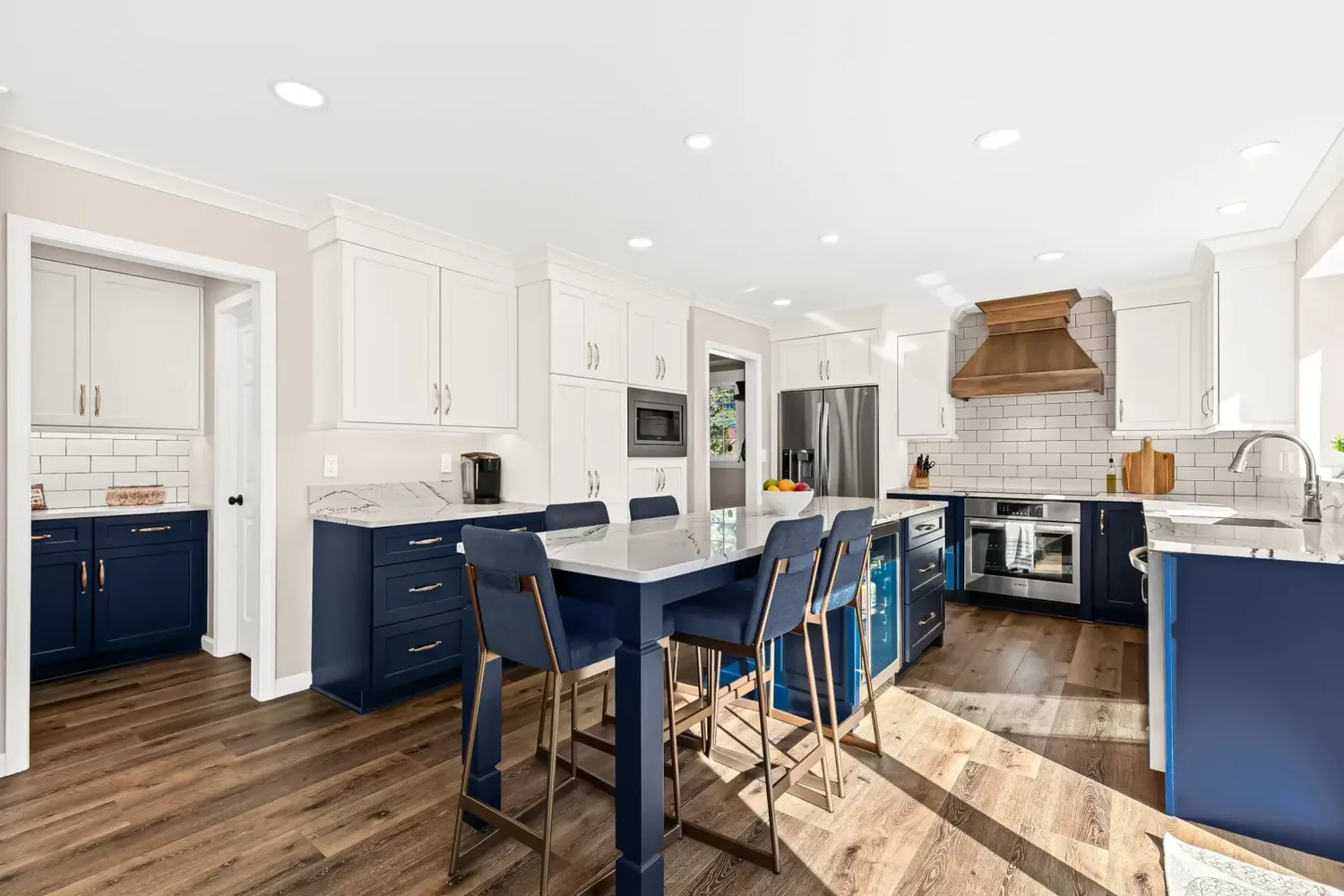
Your address decides which office issues each permit. In parts of Hamilton County, the building permit and the plumbing permit come from different offices, and in Kentucky the state issues plumbing permits. The rules below come from those offices' own pages, so treat them as a map and confirm the details for your house. For the full process, start with our kitchen remodel planning guide. The kitchen at the top is our Union, KY navy kitchen.
Which kitchen projects need a permit?
Most of a kitchen's permit needs come down to what happens behind the walls. This table covers the common pieces of a kitchen job:
| Kitchen work | Permit usually needed? | Why |
|---|---|---|
| Painting, new cabinets, new countertops, tile backsplash | No | Listed as exempt finish work in Ohio's code and by PDS of Kenton County |
| Fixing a leak or clearing a clogged drain | No, in Ohio | Exempt unless the work replaces more than one fixture |
| Moving the sink or adding a prep sink | Yes, plumbing | Ohio requires approval to install or alter plumbing; Kentucky requires a state plumbing permit |
| New circuits, outlets in new spots, new lighting circuits | Yes, electrical | Ohio requires approval to install or alter an electrical system |
| New or relocated gas line for a range | Yes | Ohio's rule names gas systems alongside plumbing and electrical |
| Range hood ducted outside | Usually | Ohio's rule covers mechanical systems |
| Removing or moving a wall | Yes, building | Ohio requires approval to alter a building; PDS says structural repairs are not ordinary repairs |
| Replacing old wiring or concealed pipe | Yes | Ohio requires approval to replace an electrical system and treats a replaced concealed pipe as new work |
What the Residential Code of Ohio says
The Ohio Board of Building Standards publishes the Residential Code of Ohio, which applies to "every one-, two-, or three-family dwelling." The 2019 edition adopts the 2018 International Residential Code with Ohio amendments. Section R105.1 covers anyone who intends to "erect, install, enlarge, alter, repair, remove, convert or replace any electrical, gas, mechanical, plumbing system." That owner or authorized agent "shall first make application to the residential building official of a certified residential building department" (Residential Code of Ohio, Chapter 1, via UpCodes).
Finish work is the surface layer of a kitchen. Section 102.10 says "approval shall not be required" for "painting, papering, tiling, carpeting, cabinets, counter tops and similar finish work." Exempt work still has to meet the board's rules.
The same section sets limits that matter in a kitchen:
- Leaks and clogs. Clearing stoppages and repairing leaks in pipes, valves or fixtures needs no approval, as long as the work does not involve "the replacement of more than one fixture."
- Concealed pipe. If a concealed trap or pipe has to be replaced, "such work shall be considered as new work and an approval shall be obtained." A leak that means opening the wall to replace pipe falls here.
- Small electrical work. "Minor repair work, including the replacement of lamps," is exempt, and so is reinstalling plug receptacles "but not the outlets thereof." New outlet locations need approval.
What the City of Cincinnati requires
Inside city limits, permits go through the Department of Buildings & Inspections (B&I). According to the city's residential permit guide, B&I enforces the residential code for one-, two- and three-family homes in Cincinnati, and it lists (513) 352-3270 for questions (City of Cincinnati Residential Permit Guide). Hamilton County Public Health's plumbing permits exclude the city, so ask B&I which office handles a plumbing permit for a Cincinnati address.
Hamilton County outside Cincinnati
Hamilton County Public Health (HCPH) issues plumbing permits "in Hamilton County (excluding the City of Cincinnati)." A contractor needs an "Ohio Contractor Industry Licensing Board (OCILB) state license," and proof of that license is required to get the permit (Hamilton County Public Health).
A homeowner can pull an HCPH plumbing permit only under three conditions. You must own and live in the single-family home where the work happens, keep living there for one year after the work is done, and complete the work yourself. HCPH also notes that "providing a copy of the building permit will greatly reduce the processing time."
For building and electrical permits, check with the building department that serves your city or township.
Do I need a permit for a kitchen remodel in Kentucky?
Yes, for plumbing, electrical and structural work. Finish work is the common exception, and Kentucky splits the trades across state and local offices.
Plumbing: the state Division of Plumbing
The Kentucky Department of Housing, Buildings and Construction (DHBC) runs plumbing permits statewide. Its Division of Plumbing states: "No person, firm or corporation shall construct, install or alter any plumbing without first having procured a plumbing construction permit from the Division of Plumbing" (Kentucky DHBC, Division of Plumbing). The division inspects installations for compliance with the Kentucky State Plumbing Code.
Homeowners can get permits "for plumbing in their own personal residences." Other plumbing work has to be done by a licensed journeyman plumber working under a licensed master plumber. The residential fee for one- and two-family homes, effective March 1, 2022, is a "$50 base permit fee, $14 per opening fee."
Electrical
Electrical permits are part of the picture in Kentucky too. In Kenton County, PDS (covered below) processes electrical permits and lists 5 business days for them, so Kenton County residents apply there. Licensing is a state matter: DHBC's Electrical Division handles the "licensing of electricians and electrical contractors" (Kentucky DHBC, Electrical Division).
Kenton County and Boone County
Kenton County. Planning and Development Services of Kenton County (PDS) issues building permits. Its exempt list matches Ohio's: "Painting, papering, tiling, carpeting, cabinets, countertops, and similar finish work." An ordinary repair, in PDS's words, is work such as "repairing/replacing drywall or a door." Structural work is different: "Repairs made to any structural element of your home are not considered ordinary repairs" (PDS of Kenton County).
PDS lists processing times for each permit type. It processes permits in the order received and warns that "permit approval times may vary depending on the workload and the information provided." Building permit questions go to (859) 957-2408.

Boone County. Boone County has its own building department. If you live there, call it to confirm what your kitchen needs.
Who issues which permit: a quick map
Our read of the offices' pages: one kitchen can involve two offices, and the split changes at the city and state lines. A sink move in Florence or Covington means a state plumbing permit plus any local building permit. The same move in a Hamilton County suburb means HCPH for plumbing and your local department for the rest.
| Area | Building permits | Plumbing permits |
|---|---|---|
| City of Cincinnati | Department of Buildings & Inspections | Ask B&I (HCPH excludes the city) |
| Hamilton County outside Cincinnati | Your city or township building department | Hamilton County Public Health |
| Kenton County, KY | PDS of Kenton County | Kentucky Division of Plumbing |
| Boone County, KY | Boone County's building department | Kentucky Division of Plumbing |
Who pulls the permit, and how inspections work
Ohio's code puts the application on "any owner or authorized agent," so either you or a contractor acting for you can apply. Homeowner permits come with conditions. HCPH requires you to do the plumbing work yourself in a home you own and live in, and Kentucky limits homeowner plumbing permits to your own residence. When you interview contractors, ask who applies for each permit and who meets the inspector.
Ohio's code has the building official provide "a list of all required inspections for each project" (Section 108.2). In Ohio, and for HCPH plumbing in Hamilton County, a kitchen's stages usually run in this order:
- Lower rough. HCPH inspects drainage piping beneath a basement floor or underground, when the job has any.
- Rough-in. HCPH calls its inspection here the upper rough: a check of "piping, sanitary, and water lines inside the house prior to dry wall." Under Ohio's code, rough electrical, plumbing and heating work must be complete and approved before the framing inspection.
- Close-in. In plain terms, this is when the walls get closed. Where your list includes it, Ohio's Section 108.2.6 calls for a drywall inspection after the board is up and before taping and finishing.
- Final. HCPH's final covers "all set plumbing fixtures: toilet, water heater, sinks, etc." Ohio's code allows the official's certificate once "final tests and inspections are completed."
In Kentucky, the state Division of Plumbing inspects plumbing installations for compliance with the Kentucky State Plumbing Code.
With Bulldog, permit applications and inspection visits for anything that changes electrical, plumbing, gas or structure are handled on our side. We pull every required permit with the appropriate Ohio, Kentucky or Indiana office and coordinate every inspection, as our remodeling process lays out. Our kitchen price ranges include design, materials, labor, permits and our lifetime workmanship warranty.
Permits affect the calendar too. A full Bulldog kitchen usually takes 4 to 8 weeks, design to finish. How long a kitchen remodel takes shows where review and inspections fall. Living without a kitchen during the remodel helps you plan the weeks the room is out of service.
Older kitchens and work done without permits
Older kitchens often hide earlier work that would not pass an inspection today: a kitchen still sharing one or two original circuits, a sink that was never vented correctly, or joists notched for old pipes. Fixing those items is part of doing the new work right. On our older-home kitchens, we check the panel, wiring, plumbing, subfloor and walls before anything is priced, so those fixes are in the quote rather than a surprise change order.
Skipping a permit on your own remodel creates a different problem. Ohio's code treats replacing concealed pipe as new work, and HCPH checks new piping before drywall. Once new cabinets and drywall cover the work, an inspector cannot see it. If earlier work in your kitchen was covered before inspection, ask your building office how it handles that before the new job starts.
Frequently asked questions
Do I need a permit to replace kitchen cabinets and countertops?
Usually not. Ohio's residential code and PDS of Kenton County both exempt cabinets, countertops, tile and painting. A permit comes into play when the job also changes plumbing, wiring or walls, and in Ohio, gas lines or ducted ventilation.
Do I need a permit to move my kitchen sink?
Yes. Ohio requires approval to alter a plumbing system, and Kentucky requires a state plumbing permit to alter plumbing. In Hamilton County outside Cincinnati, HCPH inspects the new lines before drywall.
How long does a kitchen permit take?
It depends on the office. PDS of Kenton County lists 12 business days for residential permits and 5 for electrical permits, with times that vary by workload and the information provided. HCPH says a copy of the building permit speeds up its plumbing permit.
Who is responsible for the permit, me or the contractor?
Ohio's code allows the owner or an authorized agent to apply. In Hamilton County, a homeowner plumbing permit requires doing the work yourself. In Kentucky, homeowner plumbing permits cover only your own residence. Ask anyone you interview who pulls each permit and who meets the inspector.
Plan a permitted kitchen remodel
Book an in-home consultation and we will look at what your kitchen needs and give you an itemized, fixed price that includes the permits. You can also see our kitchen remodels or call us at (513) 657-3750.
Sources
- Ohio Board of Building Standards. 2019 Residential Code of Ohio (Ohio Adm.Code 4101:8), Chapter 1, Sections R101.2, R105.1, 102.10, 108.2, 108.2.5, 108.2.6 and 111.1.1, via UpCodes.
- City of Cincinnati Department of Buildings & Inspections. Residential Permit Guide.
- Hamilton County Public Health. Plumbing Permits & Inspections. Copyright 2026.
- Kentucky Department of Housing, Buildings and Construction. Division of Plumbing. Undated; fees effective March 1, 2022.
- Kentucky Department of Housing, Buildings and Construction. Electrical Division. Undated.
- Planning and Development Services of Kenton County. Building Codes. Undated.