Key Takeaways
- Tile costs less, comes in nearly every color and shape, and lets you fix one broken piece. Its weak point is cement grout, which is porous and can absorb stains.
- Epoxy grout resists stains and does not need periodic sealing, but it costs more and sets fast. Ask for one that meets ANSI A118.3.
- A slab has few or no grout lines. Quartz needs no sealing but should not take direct heat; natural stone usually benefits from periodic sealing.
- Quartzite and marble can look alike. Test a sample with lemon juice or vinegar before you commit to a "quartzite" slab.
- In Bulldog kitchens, Essential Refresh ($35K to $55K) includes a new tile backsplash and Signature Remodel ($55K to $85K) includes a designer tile backsplash to ceiling.
A tile backsplash gives you the most color, pattern and price range, and a damaged tile can be replaced on its own. A full-height slab backsplash, cut from the same stone or quartz as your counters or a contrasting slab, has few or no grout lines and wipes clean quickly. It costs more and needs careful planning around outlets, seams and windows. Either one serves you well when it is installed carefully and cleaned the right way.
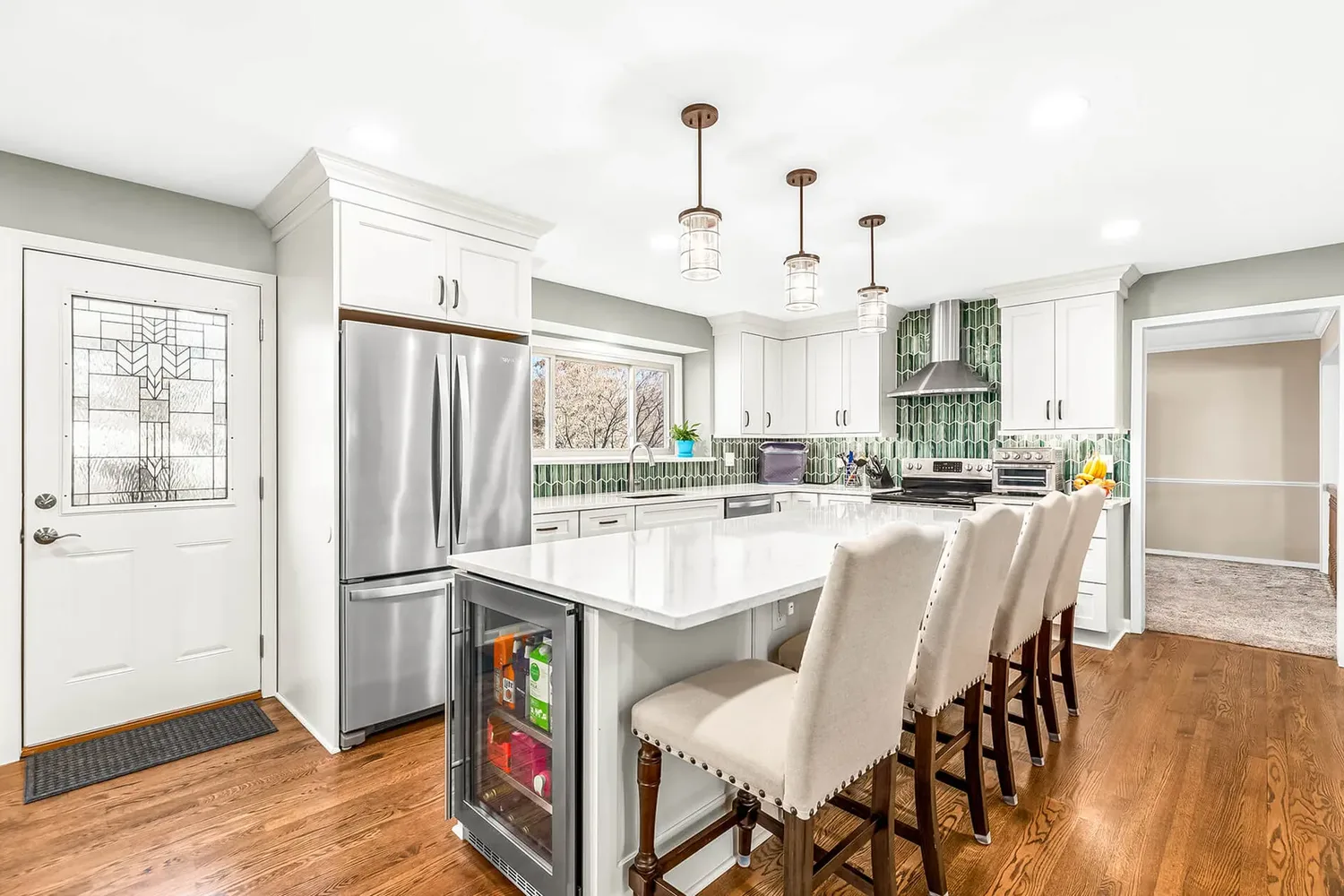
The kitchen above is our Green With Envy kitchen in Kenwood, Ohio, where shimmering green tile climbs the range wall to the ceiling.
Tile and slab backsplashes side by side
The choice comes down to grout, cost and how much pattern you want behind the range.
| Tile | Full-height slab | |
|---|---|---|
| Look | Almost any color, shape or pattern | One continuous surface, often matching the counters |
| Grout lines | Many | Few or none |
| Cleaning | Easy on glazed tile; grout needs care | Quick wipe |
| Sealing | Cement grout: yes. Epoxy grout: no | Quartz: no. Natural stone: usually, from time to time |
| Outlets and windows | Tile is cut around them | Fabricator cuts openings in the slab |
| Repairs | Replace one tile | Harder to patch a single spot |
| Relative cost | Lower to moderate | Higher |
Tile: color and pattern at any budget
Tile covers the widest range of kitchen backsplash ideas: plain white subway tile, glazed zellige, scalloped fish-scale shapes, herringbone, mosaics and handmade tile with uneven color. It is also forgiving. If you chip one piece moving a pot, a tile setter can cut it out and set a new one.
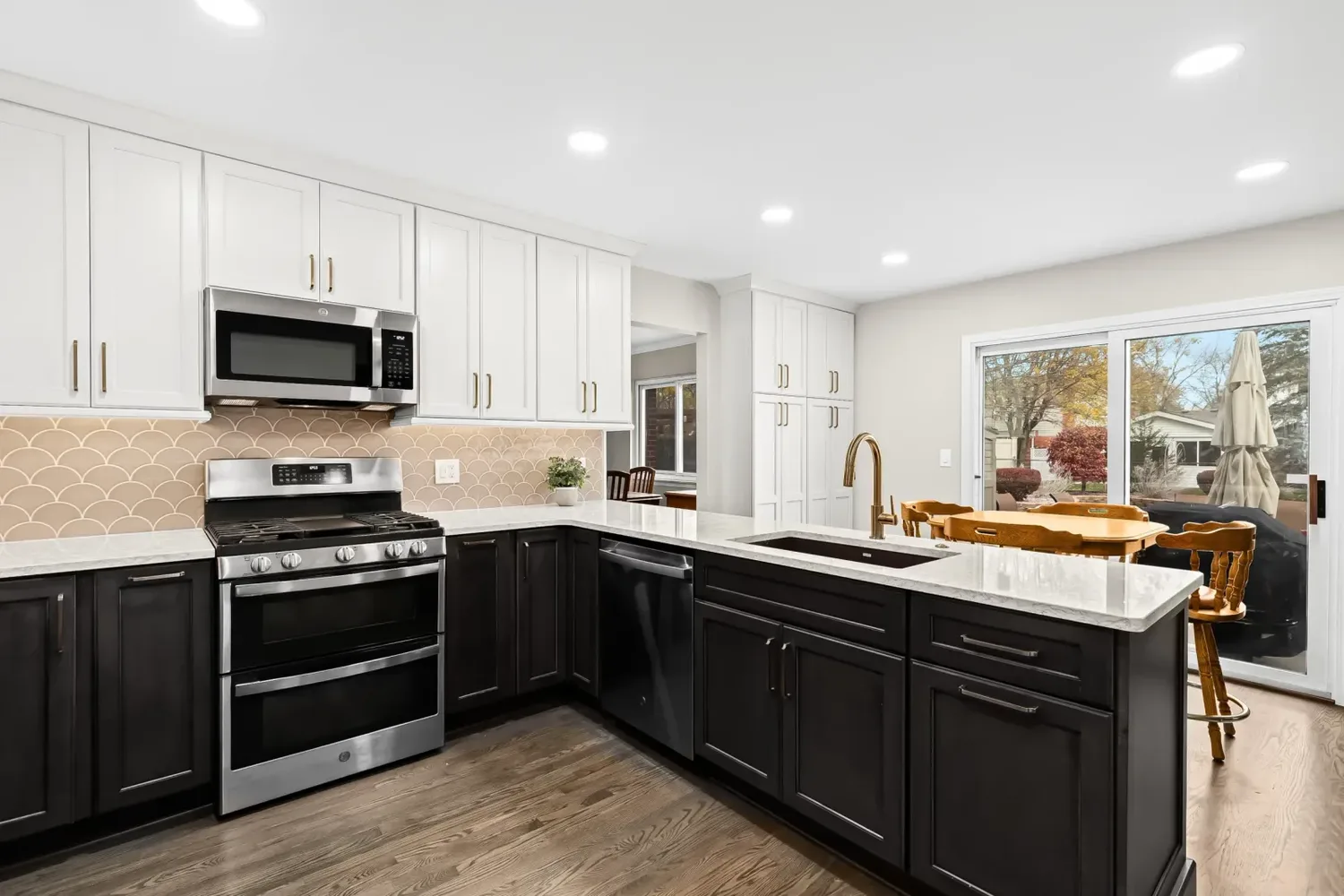
Grout is the weak spot. The Tile Council of North America (TCNA) says cement grout "is porous" and "can absorb a stain" (TCNA). Behind a range, that means grease and tomato sauce. Sealing cement grout helps, and a mid-tone grout color shows less of what does soak in.
Epoxy grout is a grout that Laticrete, a grout manufacturer, calls non-porous and "highly resistant to stains, chemicals, and moisture." Laticrete adds that it "does not require periodic sealing to maintain its properties." TCNA puts it more plainly: "if epoxy grout is used, it is virtually as stain proof as the tile." The tradeoffs are a higher initial cost and a grout that "sets faster, requiring efficient and precise application" (Laticrete, June 2025). Laticrete notes that epoxy grouts are recognized as meeting or exceeding ANSI Standard A118.3, so ask your installer for a product that meets ANSI A118.3.
How high to go. The standard approach stops the backsplash under the upper cabinets. Running tile to the ceiling on the range wall, or wherever there are no uppers, turns the backsplash into the focal point of the room. It also covers painted wall that would otherwise take grease and steam.
Which tile to choose. Glazed ceramic and porcelain are easy to wipe. Unglazed handmade tile and natural stone mosaics have more texture and need more care near the range. Small mosaics mean more grout per square foot; large-format tile means less.
Full-height slab: one surface, almost no grout
A full-height slab backsplash is a sheet of quartz or natural stone that runs from the countertop up to the uppers, the hood or the ceiling. It is cut from the same material as the counters or from a contrasting slab. The veining continues from counter to wall, and there are few or no grout lines to scrub.
Quartz slabs. Engineered quartz is a manmade surface that is "70% to 93% quartz sand or aggregate," with polyester resin binding the pieces together (Use Natural Stone, May 2019). It needs no sealing. Cambria, a quartz maker, says its surface "requires no sealing, polishing, or reconditioning," and recommends warm water, a soft cotton cloth and mild soap for cleaning (Cambria).
Quartz and heat. Cambria also says its quartz "may not withstand the direct transfer of heat from pots and pans and other cooking units" and recommends a hot pad or trivet. The stone industry goes further: Use Natural Stone, a Natural Stone Institute consumer site that promotes natural stone, calls heat damage "the biggest drawback of manufactured quartz." Neither source addresses backsplashes directly. Our recommendation: before you choose a quartz slab for the range wall, ask how close it will sit to the burners.
Natural stone slabs. Quartzite handles kitchen acids better than marble. Use Natural Stone says "Quartzite will not etch from acids like lemon juice or vinegar," while marble and dolomitic marble will (Use Natural Stone, January 2017). Natural stone usually benefits from periodic sealing. An impregnating sealer "can increase the countertop's stain resistance," and Use Natural Stone notes that many modern sealers protect stone for 1 to 10 years (Use Natural Stone, April 2019). Behind a range, grease is the stain to plan for.
Test the slab before you buy. The same source warns that "it's not even possible to tell marble and quartzite apart visually" in many cases, and reports calls from homeowners "who think their countertops are quartzite, but they get etch marks." Our advice: get a sample or offcut of the actual slab and put a few drops of lemon juice or vinegar on it. If it etches, it will not behave like quartzite behind your range.
Seams and windows. A tall wall may need more than one piece, and window returns need careful cuts. Ask where the seams will fall before the slab is cut.
Slab to a ledge, tile above: the middle option
You do not have to choose one material for the whole wall. A slab can rise from the counter to a stone ledge, with tile carrying on above it.
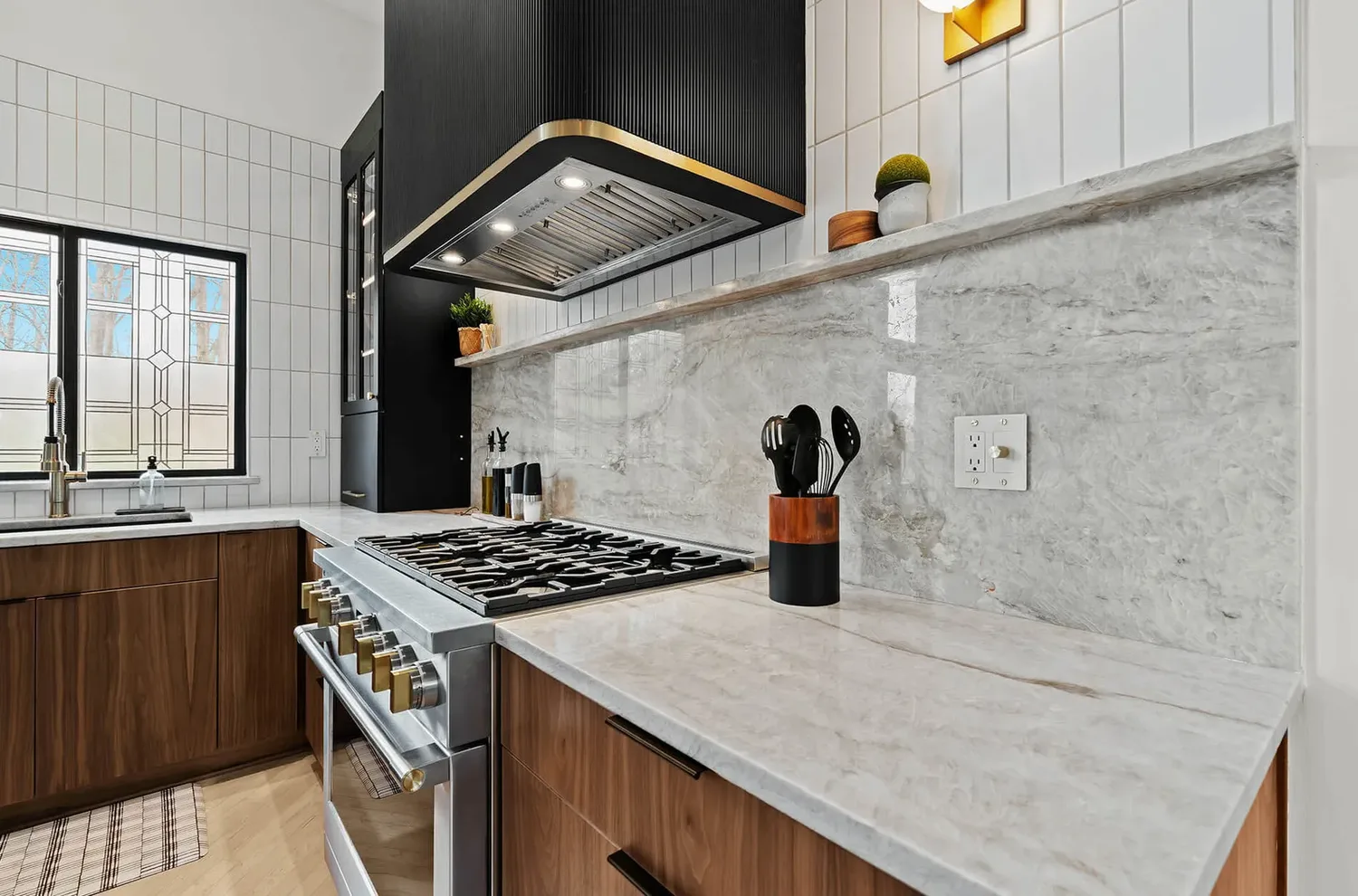
In our Covington mid-century kitchen, Taj Mahal quartzite runs up from the counter to a ledge behind the range, and white vertical stacked tile continues above it under a fluted matte black hood with a brass band. You get the stone's veining where splashes land and the texture of tile higher up.
Plan the outlets early. The same photo shows a receptacle and a switch cut into the quartzite slab. With a slab, the fabricator cuts an opening for each box, and the cut has to land where the veining still looks right. Decide where outlets and switches go before the slab is templated. Your electrician can tell you what your local code requires.
What holds up behind the range
The range wall takes heat, steam and grease every day, so it gets the toughest choice in the room.
- Easiest to keep clean: a quartz or sealed stone slab, or glazed tile with epoxy grout.
- Needs more attention: cement grout in a light color, unsealed natural stone and textured handmade tile.
- Protects the paint: taking the backsplash up to the hood or ceiling, so no painted wall sits behind the burners.
- Watch the heat: a quartz slab close to the burners, given Cambria's warning about direct heat.
A good range hood helps every option, because it pulls grease out of the air before it settles on the wall.
Which backsplash fits your kitchen
- You want color or pattern, or you are watching the budget: tile, with epoxy grout behind the range.
- You want a quiet, continuous look with your counters: a full-height slab.
- You have natural stone counters and love the veining: a slab in the same stone, etch-tested, sealed and cleaned gently.
- You want both: a slab to a ledge behind the range with tile above, or a slab on the range wall and tile elsewhere.
Pick the backsplash after the counters and cabinets, since it has to work with both. Our guides to refacing, painting or replacing cabinets and kitchen flooring cover the surfaces around it, and the kitchen remodel planning guide puts every decision in order.
Where the backsplash sits in Bulldog's kitchen packages
Our kitchen packages list the backsplash or surface materials each one includes (details on the Cincinnati kitchen remodel cost guide):
- Essential Refresh, $35K to $55K: new tile backsplash.
- Signature Remodel, $55K to $85K: designer tile backsplash to ceiling.
- Luxury Build, $85K to $120K+: premium quartz, quartzite or natural stone, the materials a slab backsplash is cut from.
The ranges include design, materials, labor, permits and our lifetime workmanship warranty. After an in-home consultation, you receive an itemized, fixed-price contract.
Frequently asked questions
Is a slab backsplash better than tile?
A slab is easier to clean, because it has few or no grout lines. Tile costs less, offers more designs and is easier to repair. Neither is better for every kitchen.
Does a quartz backsplash need sealing?
No. Cambria says its nonporous surface "requires no sealing." Natural stone backsplashes such as quartzite usually benefit from periodic sealing to improve stain resistance.
How do I keep grout from staining behind the stove?
Use epoxy grout that meets ANSI A118.3, or seal cement grout and pick a mid-tone color. Wipe grease off soon after cooking, and run the range hood when you cook.
Should a backsplash go all the way to the ceiling?
On walls with no upper cabinets, such as a range wall with a hood, running it to the ceiling looks finished and protects the wall. Under uppers, it stops at the cabinets.
Start with a 15-minute call
Book a 15-minute consultation to talk through your scope, budget and timing. If we're a good fit, we come out for an in-home estimate with samples and give you an itemized, fixed price. You can also browse our kitchen remodels or call us at (513) 657-3750.
Sources
- Laticrete. Everything You Need to Know About Epoxy Grout. June 27, 2025.
- Tile Council of North America. FAQ: Cleaning Grout. Undated.
- Cambria. Product Care FAQs. Undated.
- Karin Kirk, Use Natural Stone (Natural Stone Institute). The Definitive Guide to Quartzite. January 24, 2017.
- Stephanie Vozza, Use Natural Stone (Natural Stone Institute). Caring For Quartzite Countertops. April 4, 2019.
- Karin Kirk, Use Natural Stone (Natural Stone Institute). Sifting Through the Confusion about Manmade Quartz Surfaces. May 21, 2019.