Key Takeaways
- Porcelain tile has a water absorption of 0.5 percent or less. A PTCA mark on the box means the tile has been certified as true porcelain.
- The vinyl industry's own trade group calls rigid core vinyl "water resistant." Before you buy, check whether your flooring warranty excludes flooding or standing water from a leak.
- Solid hardwood can be sanded and refinished many times; engineered wood can be refinished fewer times.
- Tile needs a stiff floor and vinyl needs a flat one, so older houses often need subfloor work first.
- In our kitchen packages, flooring is included: LVP or tile at the Essential Refresh level, hardwood, engineered or premium tile at Signature Remodel, and wide-plank hardwood at Luxury Build.
The best kitchen flooring depends on what you need the floor to forgive. Porcelain tile is the most water resistant of the three and handles heavy wear, but it is hard and cold underfoot. Luxury vinyl plank resists spills on its surface and is softer and quieter. Hardwood is real wood that can be sanded and refinished, as long as spills get wiped up quickly. All three work in a kitchen when the subfloor under them is sound, stiff and flat.
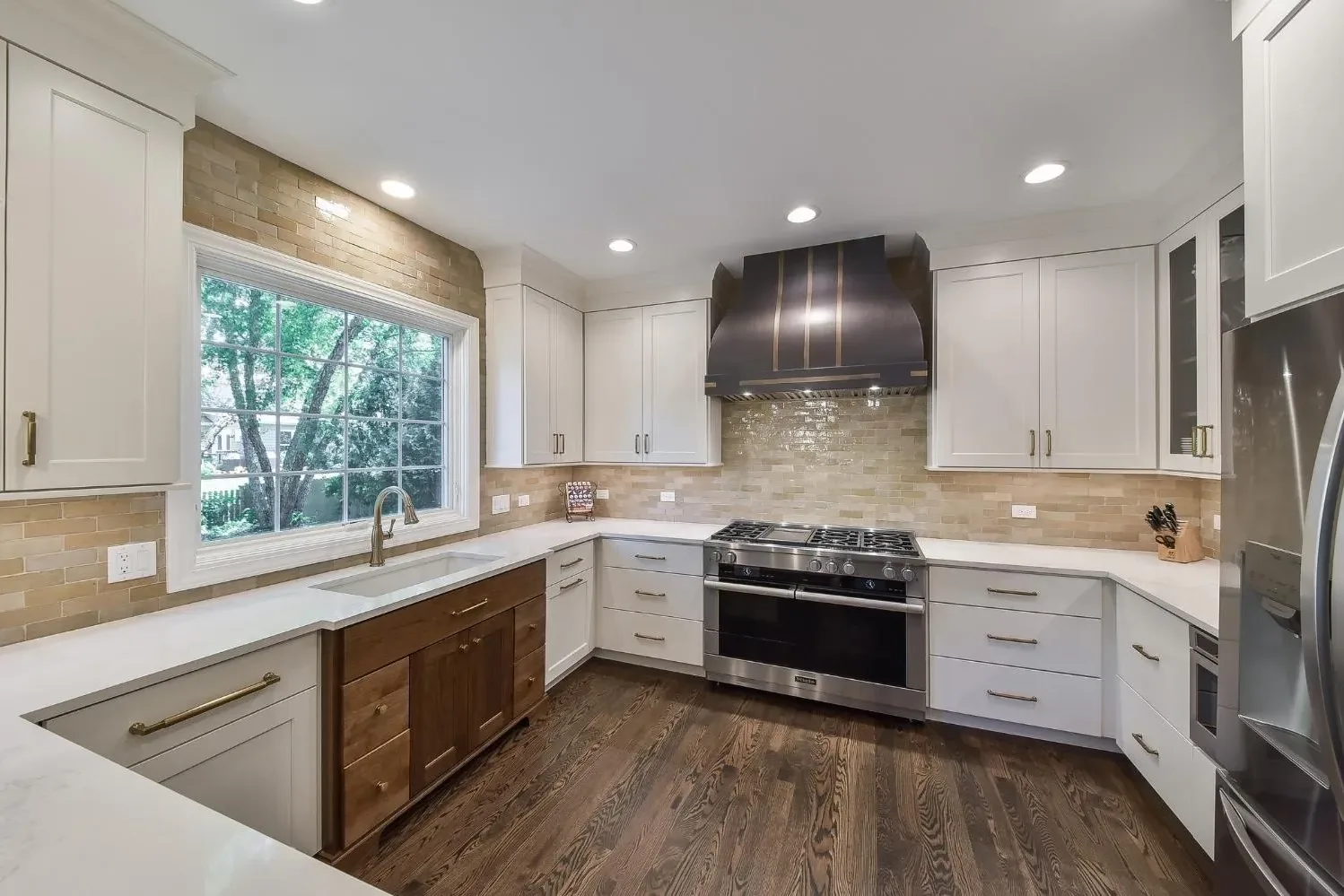
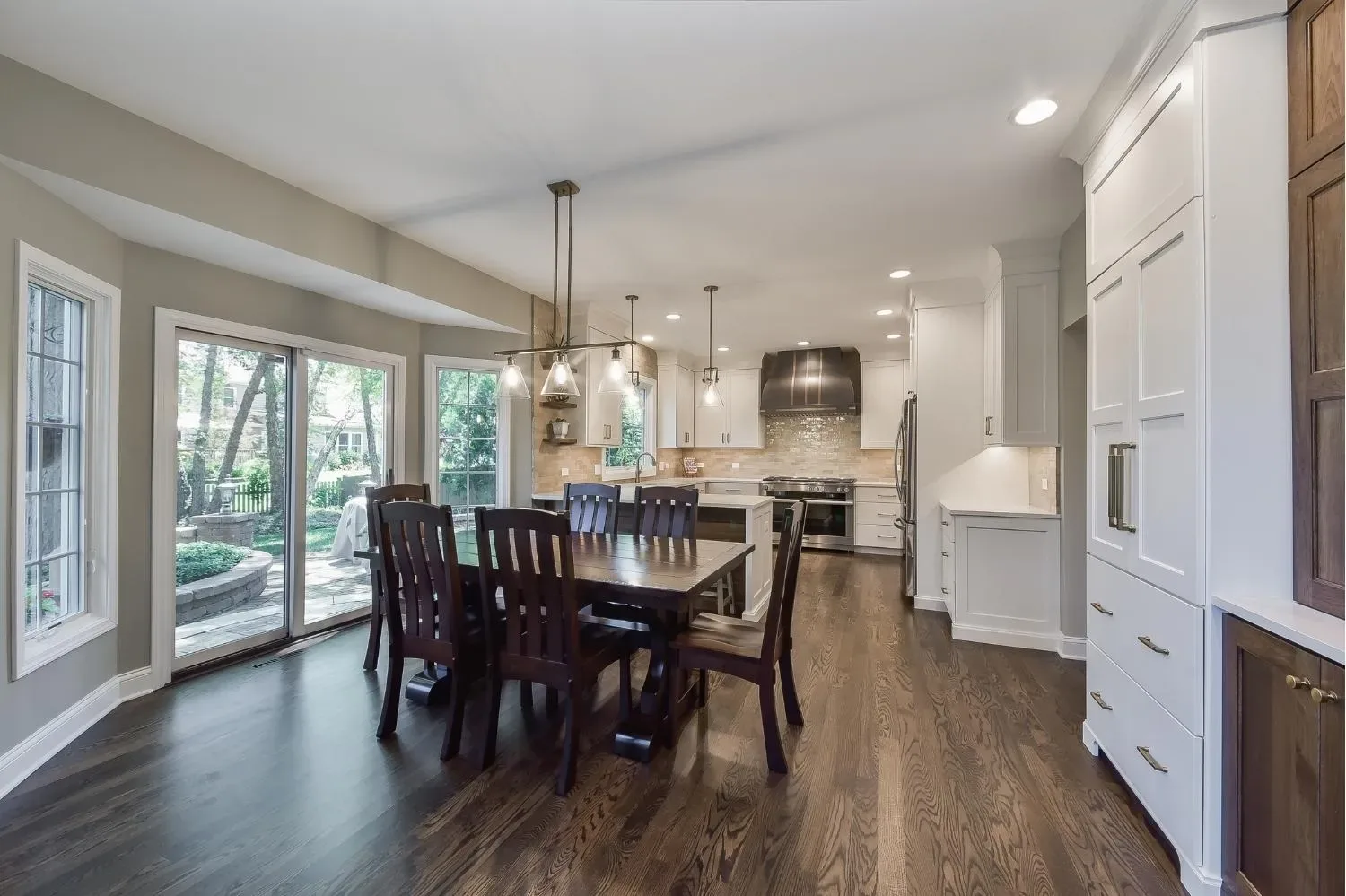
The kitchen above is our Tasteful Earthiness kitchen remodel, where rich hardwood floors run under soft white and walnut cabinetry and lead out to the sliding patio doors.
Hardwood, luxury vinyl and tile side by side
Each floor trades comfort against water resistance in a different way.
| Hardwood | Luxury vinyl plank (LVP) | Porcelain tile | |
|---|---|---|---|
| Water on the surface | Wipe up spills right away | Resists spills | Resists water |
| Water from a slow leak | Can cup, split or gap | Planks resist it, but water can reach the subfloor | Tile survives; the subfloor still matters |
| Feel underfoot | Warm, some give | Warmer and softer than tile | Hard and cold |
| Repairs | Sand and refinish | Replace planks | Replace tiles, if you kept spares |
| Looks | Real wood | Wood or stone look | Any look, including wood |
| Subfloor need | Dry and sound | Flat, to the maker's limits | Stiff enough to resist bending |
| Bulldog package | Signature Remodel, Luxury Build | Essential Refresh | Essential Refresh, Signature Remodel |
Hardwood: real wood that can be refinished
Hardwood is the floor many people picture in an older Cincinnati house, and it runs from a kitchen into a dining room with no change in height or material. A worn finish can be sanded off and renewed, which neither vinyl nor tile allows.
Solid or engineered
Solid hardwood is one piece of wood from top to bottom. The National Wood Flooring Association says solid wood "can be sanded and refinished many times" (NWFA, Types of Wood Floors). Engineered wood is also real wood, built in multiple layers. It expands and contracts less than solid wood, but it can't be refinished as many times. The NWFA adds that the number of times any floor can be sanded depends on several factors (NWFA, Refinishing Your Floors).
What it asks of you
Advice from the NWFA, republished on its consumer site, warns against "wet or steam mops, which the NWFA says will cause more damage over time." The same article says the best prevention is to "clean up spills as soon as they occur" and to keep the house between 60 and 80°F with humidity between 30 and 50 percent. That range helps the wood avoid cupping, splitting and gapping. Furniture pads on chair and stool legs prevent scratches (NWFA, Here's Exactly How To Maintain Wood Floors).
Original oak in older homes
If you have original oak under old vinyl or carpet, it can almost always be refinished. In our experience, original oak floors usually refinish beautifully. Where cabinets or walls move, ask your contractor how the gaps in the old floor will be filled, so the finished floor reads as one.
Who it suits: households that want real wood, open plans where the floor continues into other rooms, and owners who would rather refinish a floor than replace it.
Luxury vinyl plank: water resistant on top, limits below
Luxury vinyl plank (LVP) is resilient flooring made in plank form with a printed wood or stone look. The Resilient Floor Covering Institute (RFCI) describes two kinds. Flexible LVT and LVP are thin and bendable, and "an underlayment is often used to provide a moisture vapor barrier and for sound absorption" (RFCI, Flexible LVT). Rigid core vinyl (sold as WPC or SPC) has a stiff polymeric core under a decorative top surface, with an optional soft underlayment.
LVP is warmer and softer underfoot than tile and kinder to a dropped glass. It is also quieter to walk on.
What "waterproof" covers
Many packages say "waterproof." The RFCI is more careful: it says WPC and SPC cores "have water resistant capabilities" (RFCI, Rigid Core). The planks hold up to a spill on top. Water that gets under the floor from a leaking dishwasher, sink or fridge line can still reach the subfloor and the house structure.
Read the warranty before you buy, and check whether it excludes flooding or standing water from leaking plumbing or appliances. In a kitchen, those are the leaks most likely to happen.
Flat matters
Vinyl telegraphs dips and humps in the floor below it. Rigid core products "can often tolerate minor substrate variation better than flexible products," the RFCI says, but "manufacturer requirements for flatness, expansion space, moisture, and underlayment should still govern the installation." Ask to see the installation instructions for the exact product you choose.
Who it suits: busy households, kitchens with pets and kids, and anyone who wants a wood look with less worry about spills on top of the floor.
Porcelain tile: the toughest surface
Porcelain is the tile to choose for a kitchen floor. The Tile Council of North America (TCNA) defines porcelain tile as "an impervious tile with a water absorption of 0.5% or less, as measured by the ASTM C373 test method." Its Porcelain Tile Certification Agency (PTCA) program gives makers a way to prove a tile meets that standard (TCNA, Porcelain Tile Certification). Look for the PTCA mark if you want certainty.
What it asks of you
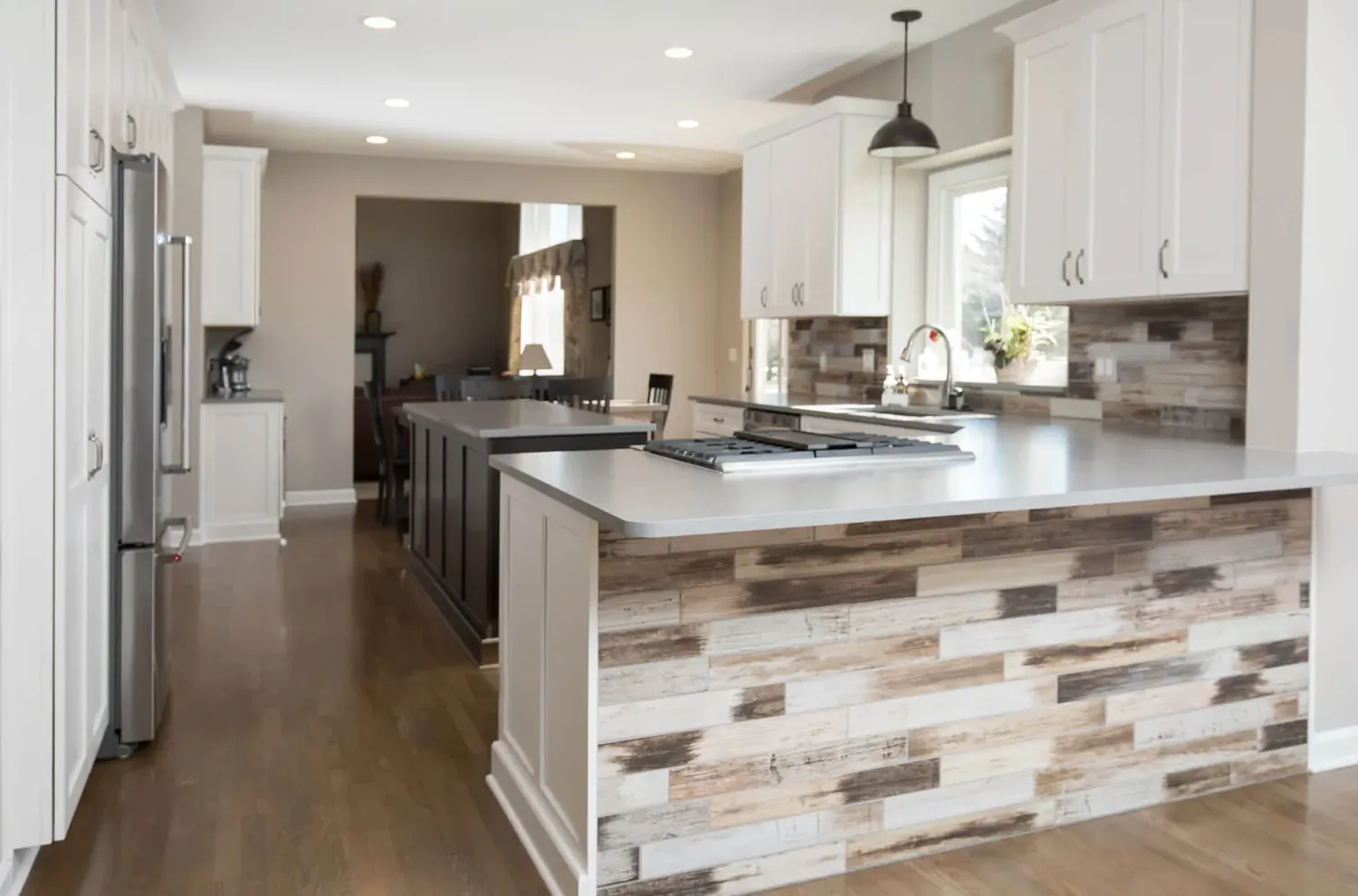
Wood-look porcelain planks give you the look of hardwood with tile's water resistance. The grout needs the care. Seal cement grout once it has cured and reseal it as the manufacturer recommends, and avoid acidic or bleach-based cleaners. Epoxy grout costs more up front but resists stains without sealing.
The tradeoffs
Tile is harder and colder underfoot than wood or vinyl. It also needs a stiff floor, because a floor that bends cracks grout and tile. Deflection is how far a floor bends under load. The TCNA says the traditional minimum stiffness for a tile floor is L/360, meaning the floor bends no more than its span divided by 360, measured before the tile underlayment goes in. It also notes that tile has failed on floors stiffer than that, at L/600 (TCNA, Deflection).
The whole floor counts, not only the top layer. If tile goes over existing sheet vinyl, the TCNA says the vinyl "must be single layer only and well attached" (TCNA, Tile Over Other Flooring).
Who it suits: kitchens that open to a back door or mudroom, homes with big dogs, and anyone whose top priority is water.
Install order: where the floor fits
In our kitchens, the sequence runs demo, rough-in electrical and plumbing, inspections, drywall, flooring, cabinets, counters, backsplash, paint, hardware and final inspection. Tile and hardwood go down before the cabinets. With a floating vinyl floor, follow the manufacturer's instructions on whether cabinets can sit on top of it.
Two questions to settle before the floor goes in: how the floor will meet the dishwasher opening, so a future replacement slides out cleanly, and how the floor will transition into the rooms next to the kitchen. Pick the floor alongside your cabinets; our guide to stock, semi-custom and custom cabinets covers that side, and our post on tile and slab backsplashes covers the wall.
Older houses: what we check first
In older homes we check the panel, wiring, plumbing, subfloor and walls before anything is priced. Uneven floors have to be addressed before new cabinets go in. Worn vinyl or laminate over a rotted subfloor comes up so the floor underneath can be fixed properly, and rot, sags and old notching are fixed before new cabinets go in. Our page on remodeling kitchens in older homes covers the rest of what we look for.
Which floor fits your kitchen
- Water is your biggest worry: porcelain tile, or wood-look porcelain.
- You stand and cook for hours and want comfort: LVP or hardwood.
- You want real wood you can refinish: solid hardwood, with spills wiped up promptly.
- You have original oak: refinish it.
- You want a wood look with easy care: LVP over a flat, dry subfloor, with a warranty you have read.
The kitchen remodel planning guide shows where flooring falls in the full sequence of decisions.
What flooring costs in a Bulldog kitchen
In our kitchen packages, flooring is included (details on the Cincinnati kitchen remodel cost guide):
- Essential Refresh, $35K to $55K: LVP or tile flooring.
- Signature Remodel, $55K to $85K: hardwood, engineered or premium tile flooring.
- Luxury Build, $85K to $120K+: wide-plank hardwood with custom inlays.
The ranges include design, materials, labor, permits and our lifetime workmanship warranty. Every project is quoted line by line and locked with our Price Guarantee. Significant subfloor or joist work is quoted separately and only when we find it.
On flooring, our workmanship warranty covers our subfloor prep and the installation. The flooring itself carries its manufacturer's own warranty.
Frequently asked questions
Is LVP or hardwood better in a kitchen?
LVP handles spills on its surface better and is softer and quieter underfoot. Hardwood adds real wood to the house and can be sanded and refinished, solid wood many times. If spills and pets worry you most, choose LVP; if you want a floor you can renew, choose hardwood.
Is luxury vinyl plank really waterproof?
The planks resist water on top, and the RFCI describes rigid core vinyl as "water resistant." Water that gets under the floor from a leaking dishwasher or a flood can still reach the subfloor. Check whether your warranty excludes standing water from leaking plumbing or appliances.
Is tile too cold for a kitchen floor?
Porcelain is colder and harder underfoot than wood or vinyl. Many people accept that for tile's water resistance; if comfort comes first, LVP or hardwood is the better fit.
Can I keep my old hardwood floor in a new kitchen?
Often, yes. Original oak floors usually refinish beautifully. If cabinets or walls move, plan how the old floor will be filled where they stood.
Talk through flooring for your kitchen
Start with a 15-minute call to talk through scope, budget and timing. If we're a good fit, we book an in-home estimate, check your subfloor, and give you an itemized, fixed price. Book through our consultation page, browse our kitchen remodels, or call (513) 657-3750.
Sources
- National Wood Flooring Association. Here's Exactly How To Maintain Wood Floors. woodfloors.org, October 10, 2023 (reprinted from House Beautiful).
- National Wood Flooring Association. Types of Wood Floors. woodfloors.org.
- National Wood Flooring Association. Refinishing Your Floors. woodfloors.org.
- Resilient Floor Covering Institute. Rigid Core. rfci.com.
- Resilient Floor Covering Institute. Flexible LVT. rfci.com.
- Tile Council of North America. Porcelain Tile Certification. September 9, 2025.
- Tile Council of North America. Deflection. tcnatile.com.
- Tile Council of North America. Tile Over Other Flooring. tcnatile.com.